

Starting a career in digital marketing can be exciting, but choosing your first digital marketing specialization can also be confusing. With options like Search Engine Optimization (SEO), social media marketing, content marketing, paid advertising, and analytics, beginners often struggle to decide which path suits them best.
You might enjoy creating Instagram content, researching information on Google, writing blogs, or analysing numbers. Each interest can point toward a different area of digital marketing.
For students in Perinthalmanna, Malappuram, and other parts of Kerala, understanding these specializations can help you make informed decisions before joining a digital marketing course or exploring internship opportunities.
The good news is that you don’t need to master everything at once. You can begin by understanding the different fields, trying practical projects, and choosing the area you enjoy learning.
In this guide, you’ll discover the major digital marketing specializations, their required skills, and practical steps to help you choose your first career direction.
What Is a Digital Marketing Specialization?
A digital marketing specialization is a specific area of online marketing in which you develop deeper knowledge and practical skills.
Digital marketing includes several activities, such as improving website visibility, managing social media content, creating advertisements, and analysing campaign performance.
For example, imagine a clothing store in Perinthalmanna that wants to attract more customers.
An SEO specialist might improve the store’s website so people can discover it through Google. A social media marketer could create Instagram content showcasing new collections. A paid advertising specialist might plan online advertisements to reach interested customers.
Although these activities serve a common business goal, each requires different skills.
Choosing a specialization means selecting an area where you want to develop stronger expertise. It doesn’t mean you must stop learning about other digital marketing fields.
Why Is Choosing the Right Specialization Important?
Digital marketing is a broad subject, and learning everything at the same time can feel overwhelming for beginners.
Choosing a specialization helps you focus your time on specific skills, tools, and practical projects.
For example, if you enjoy writing and researching topics, SEO or content marketing may suit you. If you like creative communication, social media marketing may be more interesting. Students who enjoy numbers and problem-solving might prefer paid advertising or analytics.
However, choosing a specialization based only on popularity or salary expectations may not be the best approach.
A field may appear attractive online, but its daily responsibilities could be very different from what you expect.
The better approach is to understand the work, explore your interests, and practise before deciding.
Your first specialization should give you a clear learning direction without limiting your future career options.
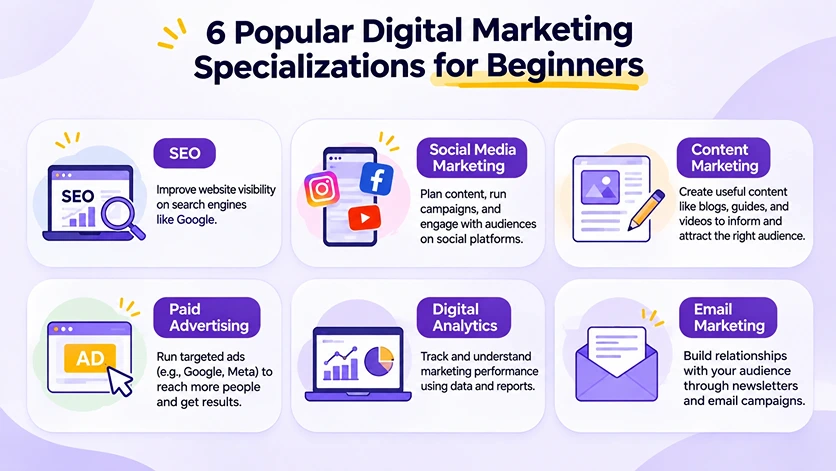
6 Popular Digital Marketing Specializations for Beginners
Digital marketing includes several career paths. Understanding what each specialization involves can help you identify the skills you would like to develop.
Specialization | Main Responsibilities | Suitable Interests |
SEO | Keyword research, website optimization, search performance | Research, writing, websites |
Social Media Marketing | Content planning, social campaigns, audience communication | Creativity, communication |
Content Marketing | Blogs, articles, guides, educational content | Writing, storytelling |
Paid Advertising | Campaign planning, budgeting, advertisement analysis | Numbers, business strategy |
Digital Analytics | Website reports, campaign measurement, data analysis | Problem-solving, data |
Email Marketing | Newsletters, subscriber communication, email campaigns | Writing, organization |
1. Search Engine Optimization (SEO)
Search Engine Optimization, commonly known as SEO, focuses on improving websites so search engines can understand their content and users can find relevant information.
SEO professionals may research keywords, improve website content, examine website structure, and review search performance.
For example, imagine a bakery in Perinthalmanna wants more people to find its website when searching for birthday cakes.
An SEO learner could research terms that potential customers might search for and suggest useful information for the bakery’s website.
SEO may suit you if you enjoy:
- Researching information and finding answers.
- Writing and improving website content.
- Understanding how Google Search works.
- Solving problems and learning about websites.
One challenge with SEO is that improvements may take time to show results. Higher rankings or increased website traffic are never guaranteed.
Beginner project: Research five keywords for a fictional local bakery and prepare a simple webpage content plan.
You can explore Google’s SEO Starter Guide to learn the basics.
2. Social Media Marketing
Social media marketing involves using platforms such as Instagram, Facebook, and LinkedIn to communicate with audiences and support marketing goals.
Social media marketers plan content, create posts, write captions, research audiences, and review campaign performance.
For example, imagine a café near a college in Perinthalmanna wants students to know about its new snack menu.
A social media marketer might create Instagram posts introducing the menu, highlighting the café environment, and sharing useful updates.
Social media marketing may suit you if you enjoy:
- Creating visual content and developing creative ideas.
- Writing engaging captions.
- Communicating with different audiences.
- Understanding social media trends and user behaviour.
However, social media marketing isn’t only about creating Reels or gaining followers. It also involves planning content around clear goals and measuring its usefulness.
Beginner project: Create a seven-day Instagram content calendar for a fictional café. Include post ideas, captions, and the purpose of each post.
3. Content Marketing
Content marketing focuses on creating useful information that helps a specific audience.
It includes blog articles, educational videos, guides, newsletters, and other informative content.
For example, a tuition centre in Malappuram might publish articles about exam preparation, study techniques, and choosing educational courses.
A content marketer could research these questions and prepare articles that students find useful.
Content marketing may suit you if you enjoy:
- Writing and explaining ideas.
- Researching different topics.
- Storytelling and creative thinking.
- Organizing information clearly.
Content marketing often works alongside SEO because useful articles can answer audience questions while supporting website visibility.
However, producing good content requires research, editing, and fact-checking. Simply publishing more content doesn’t automatically improve marketing results.
Beginner project: Write a 500-word article about a topic that interests students. Focus on making the information accurate and easy to understand.
4. Paid Advertising and Performance Marketing
Paid advertising involves promoting businesses through paid placements on platforms such as Google and Meta.
Performance marketing focuses on measurable campaign objectives, such as generating relevant enquiries, registrations, or purchases.
Paid advertising professionals may research audiences, write advertisement messages, plan budgets, monitor performance, and test improvements.
For example, imagine a sports shop in Perinthalmanna wants to promote its new collection of running shoes.
A beginner could design a sample advertising campaign explaining the target audience, advertisement message, spending limit, and expected customer action.
Paid advertising may suit you if you enjoy:
- Working with numbers and budgets.
- Understanding business goals.
- Testing different marketing ideas.
- Analysing campaign reports.
One important challenge is that real advertising campaigns involve spending money. Without proper planning, advertising budgets can be wasted.
Beginners should start with fictional campaign plans or supervised activities before managing real business budgets.
Beginner project: Prepare a sample advertising campaign with a fictional ₹1,000 budget. Explain the campaign goal, target audience, and how you would measure results.
Google provides official learning resources through Google Ads Skillshop.
5. Digital Marketing Analytics
Digital marketing analytics involves collecting and understanding information about website visitors, advertising campaigns, and other marketing activities.
Analytics helps marketers answer questions such as:
- How do visitors discover a website?
- Which marketing channels attract visitors?
- What actions do visitors complete?
- Which campaigns appear to support business goals?
- What could be improved?
For example, imagine an online store receives website visitors from Google Search and Instagram.
An analytics learner could examine demonstration data to compare visits from different channels and understand how visitors interact with the website.
Analytics may suit you if you enjoy:
- Working with information and numbers.
- Identifying patterns.
- Solving logical problems.
- Understanding why results change.
You don’t need advanced mathematics to begin learning basic marketing analytics. However, interpreting data correctly takes practice.
More website visitors don’t always mean more customers or better business results.
Beginner project: Explore the Google Analytics demo account and write three observations from a sample report.
6. Email Marketing
Email marketing involves communicating with people who have agreed to receive messages from a business.
It can include welcome emails, newsletters, customer updates, and educational messages.
For example, an online stationery shop might send welcome emails to new subscribers, introducing its products and sharing useful information.
Email marketing may suit you if you enjoy:
- Writing clear and useful messages.
- Organizing information.
- Understanding customer interests.
- Planning communication.
An important part of email marketing is respecting privacy, consent, and unsubscribe preferences.
Beginner project: Create three welcome emails for a fictional online store. Explain why each email would be useful to subscribers.
How to Choose the Right Digital Marketing Specialization
Now that you understand the different fields, how should you decide which one to learn first?
Here are five practical steps.
Step 1: Identify Your Interests
Start by thinking about activities you naturally enjoy.
Do you like researching information, writing explanations, creating visual content, or working with numbers?
Your interests can help you identify suitable starting points.
For instance, students who enjoy research may explore SEO, while students who like creative communication may prefer social media marketing.
Step 2: Understand the Daily Responsibilities
A specialization may sound interesting until you understand what professionals actually do.
For example, enjoying Instagram doesn’t necessarily mean you will enjoy managing social media accounts for businesses.
Professional work includes planning, research, audience communication, and performance reviews.
Learn about the daily activities of each specialization before making your choice.
Step 3: Try Small Projects
Practical activities can help you discover what interests you.
Create an Instagram content calendar, research keywords, write a blog article, or prepare a sample advertising campaign.
You don’t need real clients for these beginner exercises. Clearly label fictional projects as practice work.
Step 4: Evaluate Your Experience
After completing a project, ask yourself:
- Did I enjoy the activity?
- Did I understand the purpose of the work?
- Was I interested in solving the problems?
- Would I like to learn more?
- Am I willing to practise this regularly?
Don’t reject a specialization only because the first task was difficult. New skills usually require time and practice.
Step 5: Choose One Starting Point
Select a specialization that interests you and begin developing deeper skills.
Continue learning the fundamentals of other marketing areas because different digital marketing activities often work together.
Your first choice doesn’t need to be permanent.
A Simple Seven-Day Plan to Explore Digital Marketing
If you’re still unsure, try this practical learning plan before choosing your specialization.
Day | Activity | What You’ll Explore |
Day 1 | Learn basic digital marketing concepts | How different channels work |
Day 2 | Research five keywords for a local business | SEO |
Day 3 | Create three Instagram post ideas | Social media marketing |
Day 4 | Write a short educational article | Content marketing |
Day 5 | Prepare a fictional advertisement plan | Paid advertising |
Day 6 | Review sample analytics data | Marketing analytics |
Day 7 | Compare your interests and learning experience | Specialization selection |
After completing these activities, rate each experience based on enjoyment, confidence, and willingness to practise again.
The goal isn’t to discover a perfect career immediately. It’s to identify a useful direction for further learning.
Common Mistakes to Avoid When Choosing a Specialization
Choosing a specialization without understanding its responsibilities can lead to confusion.
Here are some common mistakes students should avoid.
- Choosing based only on popularity: A popular field may not match your interests or preferred working style.
- Following unsupported salary promises: A specialization does not guarantee a particular salary or job opportunity. Career outcomes depend on many factors.
- Trying to master everything immediately: Learning several tools without understanding their purpose can make progress difficult.
- Depending only on certificates: Certificates can demonstrate course completion, but practical skills and relevant projects also matter.
- Ignoring practical experience: Reading about digital marketing is useful, but completing projects can help you understand the actual work.
To explore related learning challenges, read Common Mistakes Students Make While Learning Digital Marketing.
How to Build Your First Digital Marketing Portfolio
A portfolio is a collection of projects that demonstrates your skills and learning.
Even without real client experience, you can create practice projects for fictional businesses.
For example:
- SEO: Prepare a keyword research report for a local bakery.
- Social media: Create a content calendar for a café.
- Content marketing: Write educational blog articles.
- Paid advertising: Develop a sample campaign plan.
- Analytics: Review demonstration data and prepare a short report.
- Email marketing: Write a welcome email sequence.
For each project, explain the business objective, audience, work completed, and lessons learned.
Never present fictional campaigns as real client projects or invent performance results.
You can also prepare for interview questions using your portfolio.
Example interview question: Why did you choose SEO as your specialization?
Sample answer:
“I explored several digital marketing activities through beginner projects. I enjoyed researching customer questions and planning website content. After creating a keyword research project for a fictional bakery, I became interested in learning more about SEO and how to measure website performance.”
This answer demonstrates your interest and learning experience without making unsupported claims.
What Should You Look for in a Digital Marketing Course?
Once you’ve explored your interests, you may decide to join a structured digital marketing course.
Before choosing a programme, review its curriculum and learning approach.
Consider these questions:
- Does the course explain digital marketing fundamentals?
- Does it introduce different specializations?
- Are practical projects and assignments included?
- Will you receive useful feedback?
- Does the course cover tools relevant to your interests?
- Are course fees, schedules, and requirements clear?
- Are internship opportunities and career-support services explained accurately?
For students exploring digital marketing education in Perinthalmanna, Dexta Academy publishes information about training in SEO, social media, paid advertising, analytics, and related areas.
You can explore the digital marketing course curriculum for students and compare the available learning options with your goals.
Remember that completing a course doesn’t guarantee employment. Continued practice, relevant skills, and employer requirements also influence career opportunities.
Frequently Asked Questions
❓Which digital marketing specialization is best for beginners?
There is no single best specialization. SEO and content marketing may suit students who enjoy research and writing, while social media marketing may interest creative learners. Analytics and paid advertising may appeal to students who enjoy numbers and problem-solving. Small projects can help you choose.
❓Is SEO better than social media marketing for a career?
Neither specialization is automatically better. SEO focuses on website visibility and search behaviour, while social media marketing focuses on content planning and audience communication. Both involve creative and analytical skills. Choose based on the work you enjoy.
❓Can I learn digital marketing without coding?
Yes. Beginners can start with keyword research, content writing, social media planning, and basic reporting without advanced coding knowledge. Technical skills may become useful as you develop expertise in certain areas.
❓Can students from different academic streams learn digital marketing?
Yes. Students from commerce, science, humanities, and other backgrounds can begin learning digital marketing fundamentals. Your academic stream doesn’t determine which specialization you can explore.
❓Can I change my digital marketing specialization later?
Yes. Digital marketing skills overlap, making it possible to explore different areas as your interests develop. You may need additional training and projects when moving into a new role.
❓Can I build a digital marketing portfolio without clients?
Yes. Beginners can create fictional projects such as keyword reports, content calendars, sample advertisements, and analytics reports. Clearly identify these as practice projects and avoid claiming results you didn’t achieve.
❓Does completing a digital marketing course guarantee a job?
No. Completing a course or choosing a specialization doesn’t guarantee a job, internship, or salary. Employers consider skills, experience, portfolio work, interviews, and role requirements.
Choosing your first digital marketing specialization is about understanding your interests and identifying the kind of work you want to practise.
If you enjoy researching and writing, SEO or content marketing may be a suitable starting point. If you prefer creative communication, explore social media marketing. If numbers and performance reports interest you, consider paid advertising or analytics.
For students in Perinthalmanna and across Kerala, practice projects based on familiar local businesses can make digital marketing easier to understand.
You don’t need to learn everything before getting started.
Choose one area, practise regularly, build a portfolio, and continue improving your skills.
Your first specialization is simply the beginning of your digital marketing learning journey.
Ready to Start Your Digital Marketing Journey?
Still unsure which digital marketing specialization is right for you? Explore SEO, social media marketing, paid advertising, and more with practical learning opportunities at Dexta Academy, Perinthalmanna.
Take the first step toward building your digital marketing skills.
Explore Our Digital Marketing CourseAbout The Author

Raees Addox
Raees Addox is a digital marketing leader with 7+ years of industry experience, working at the intersection of digital marketing, sales, and AI. He is the Co-Founder of Addox Digital and Co-Founder & CEO of Dexta Academy.
0 Comment