

Your Google Ads or Meta Ads dashboard looks healthy. CTR is good, CPC is affordable, and CPL is falling.
Then sales says:
“The leads are not good.”
This is where performance marketing becomes more than reading dashboard numbers.
For students, job seekers, junior marketers and business owners, the real skill is understanding what each metric tells you—and what it does not.
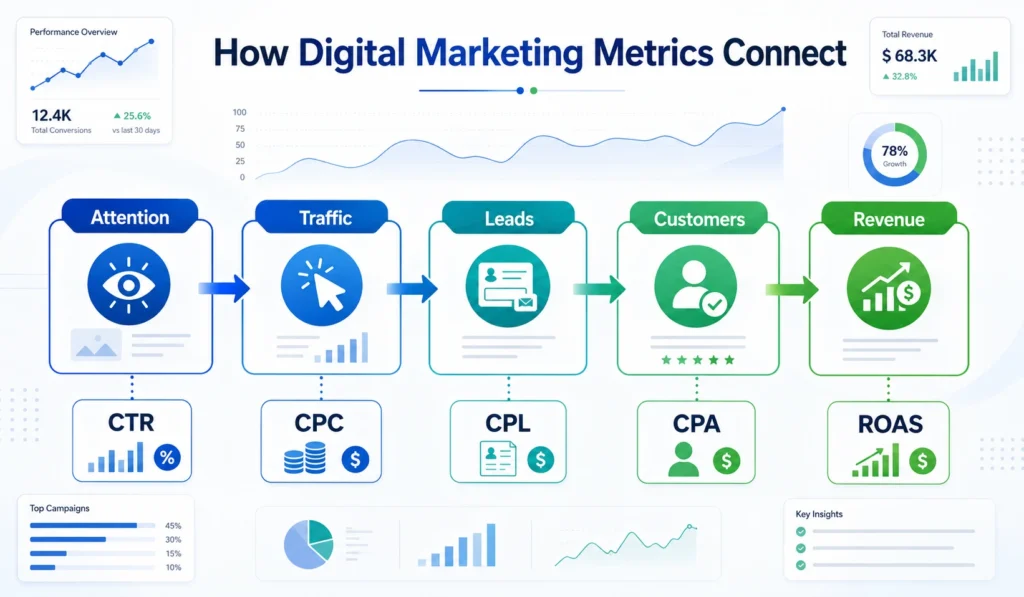
A campaign can look efficient inside the ad platform while producing weak enquiries, few customers or poor revenue. The five core digital marketing metrics should therefore be read as one connected chain:
CTR → CPC → CPL → CPA → ROAS
Or, in business terms:
Attention → Traffic → Leads → Customers → Revenue
Performance Marketing Rule: Cheap clicks and cheap leads matter only if they eventually produce qualified prospects, customers and sustainable revenue.
Digital Marketing Metrics: How CTR, CPC, CPL, CPA and ROAS Connect
Stage | Main Metric | Main Question |
Attention | CTR | Are the right people responding? |
Traffic | CPC | What are we paying for visits? |
Leads | CPL | What does each enquiry cost? |
Acquisition | CPA | What does each desired outcome cost? |
Revenue | ROAS | Is ad spend generating enough revenue? |
A strong performance marketer does not stop at “CTR improved” or “CPC dropped.” The better question is: What happened next?
If tracking stops at a form submission, CPL may be the deepest useful metric. If your CRM records qualified leads and customers, cost per qualified lead and CPA become more meaningful. If revenue can be attributed reliably, ROAS adds the commercial view.
That is the difference between reading dashboard numbers and analysing campaign performance.
What Is CTR and What Does It Really Tell You?
CTR, or click-through rate, measures how often people click after seeing an ad.
CTR Formula
CTR = Clicks ÷ Impressions × 100
For example, 50,000 impressions and 1,500 clicks produce a CTR of 3%.
CTR helps diagnose ad relevance, creative strength, keyword-to-ad alignment, audience response and offer clarity. But a high CTR does not prove that the traffic is valuable.
An ad promising a broad free consultation may attract more clicks than one that clearly states location, service fit or eligibility. The second ad may still produce better prospects.
What Is CPC and When Is a Higher CPC Acceptable?
CPC, or cost per click, tells you how much you pay for each visit generated through an ad.
CPC Formula
CPC = Advertising Spend ÷ Clicks
If a campaign spends ₹50,000 and receives 1,000 clicks:
CPC = ₹50
A lower CPC means cheaper traffic. It does not automatically mean better traffic.
Consider Campaign A with a CPC of ₹30 and Campaign B with a CPC of ₹60. Campaign A looks cheaper, but if Campaign B produces more qualified enquiries and customers, the higher CPC may be justified.
Insider POV: Treat CPC as an input cost, not a final success metric.
This is useful in Kerala campaigns where location and search intent matter. A high-intent search in Kochi, for example, should not automatically be compared with broad traffic targeting the whole state.
What Is CPL and Why Can Cheap Leads Be Misleading?
CPL, or cost per lead, measures how much marketing spend is required to generate an enquiry.
CPL Formula
CPL = Lead-Generation Spend ÷ Leads
If you spend ₹80,000 and generate 160 leads:
CPL = ₹500
The calculation is simple. Defining a lead is harder.
A business may count every form submission, WhatsApp message or phone call as a lead. Another may count only enquiries within the service area, prospects who meet sales criteria or booked appointments.
That distinction matters because businesses using WhatsApp, phone calls and website forms can receive very different levels of intent from each source.
Before using CPL as a serious performance target, marketing and sales should agree on what counts as a valid lead.
CPL vs Qualified CPL: The Metric Most Teams Miss
Raw CPL can hide major differences in lead quality.
Campaign A
Spend: ₹100,000. Leads: 200. Raw CPL: ₹500. Qualified leads: 40. Cost per qualified lead: ₹2,500.
Calculation:
₹100,000 ÷ 40 = ₹2,500
Campaign B
Spend: ₹100,000. Leads: 125. Raw CPL: ₹800. Qualified leads: 75. Cost per qualified lead: approximately ₹1,333.
Calculation:
₹100,000 ÷ 75 ≈ ₹1,333
Metric | Campaign A | Campaign B |
Spend | ₹100,000 | ₹100,000 |
Leads | 200 | 125 |
Raw CPL | ₹500 | ₹800 |
Qualified Leads | 40 | 75 |
Cost per Qualified Lead | ₹2,500 | ≈ ₹1,333 |
Campaign A looks better at the raw CPL level, but Campaign B becomes much stronger after lead quality is considered.
Key Takeaway: Cheap leads can become expensive when most of them are poor fits.
These figures are illustrative examples, not Kerala industry benchmarks or real client results.
What Is CPA and Why Does It Matter More Than CPL?
CPA means cost per action or cost per acquisition, depending on how the business defines the target conversion.
CPA Formula
CPA = Total Marketing Cost ÷ Desired Actions
If a campaign spends ₹120,000 and produces 20 customers or other defined acquisition actions:
CPA = ₹6,000
The desired action could be a completed appointment, an enrolled student, a qualified property visit, a subscription, a purchase, a sales-qualified opportunity or a closed customer.
CPL asks:
“What does it cost to generate an enquiry?”
CPA asks:
“What does it cost to achieve the outcome we actually care about?”
For many lead-generation businesses, that makes CPA more useful for commercial decisions.
What Is ROAS and Why Is ROAS Not Profit?
ROAS means return on ad spend.
ROAS Formula
ROAS = Revenue Attributed to Ads ÷ Advertising Spend
If you spend ₹100,000 and generate ₹400,000 in attributed revenue:
ROAS = 4x, or 400%
ROAS is not profit.
That revenue may still need to cover product or service delivery, salaries, sales commissions, payment fees, discounts, returns, overheads and taxes where applicable.
A 4x ROAS may work for one company and fail for another. The right target depends on margins, operating costs and customer economics.
CTR vs CPC vs CPL vs CPA vs ROAS: Which Matters Most?
There is no single best metric.
Metric | Best Used For | Main Limitation |
CTR | Ad response and relevance | Does not show post-click quality |
CPC | Traffic-cost monitoring | Cheap traffic can convert poorly |
CPL | Lead-generation efficiency | Treats strong and weak leads equally |
CPA | Acquisition efficiency | Depends on a meaningful conversion definition |
ROAS | Attributed revenue efficiency | Revenue is not profit |
For most lead-generation teams, the measurement path is straightforward: use CTR to understand whether the ad earns attention, CPC to understand traffic cost and CPL to measure enquiry-generation efficiency. Once sales qualification is available, add cost per qualified lead and CPA. When revenue attribution is reliable, use ROAS to judge commercial performance.
Where Optimization Effort Usually Pays Off
Improvement | Effort | Potential Business Impact |
Improve weak ad messaging | Low | Medium |
Remove irrelevant traffic | Low–Medium | Medium |
Improve landing-page relevance | Medium | High |
Add lead qualification | Medium | High |
Connect CRM outcomes to campaigns | High | Very High |
Beginners often focus on CTR, clicks and CPC because those numbers are easiest to see. Stronger campaign analysis connects them with lead quality, sales outcomes and revenue.
Kerala Campaign Example: Cheap Leads vs Better Customers
Consider two illustrative Kerala lead-generation campaigns with the same advertising budget. These figures are not Kerala advertising benchmarks or real client results.
Campaign A: Cheaper Traffic and Leads
Campaign A records 150,000 impressions, 3,000 clicks, ₹120,000 in spend, 180 leads, 12 customers and ₹360,000 in attributed revenue. Its CTR is 2.0%, CPC is ₹40, CPL is ₹667, CPA is ₹10,000, and ROAS is 3x.
Campaign B: Higher-Intent Traffic
Campaign B records 80,000 impressions, 2,000 clicks, ₹120,000 in spend, 140 leads, 20 customers and ₹600,000 in attributed revenue. Its CTR is 2.5%, CPC is ₹60, CPL is ₹857, CPA is ₹6,000, and ROAS is 5x.
Metric | Campaign A | Campaign B |
CPC | ₹40 | ₹60 |
CPL | ₹667 | ₹857 |
Customers | 12 | 20 |
CPA | ₹10,000 | ₹6,000 |
Attributed Revenue | ₹360,000 | ₹600,000 |
ROAS | 3x | 5x |
Campaign B has a 50% higher CPC and roughly 29% higher CPL. Yet it produces 20 customers vs 12, a ₹6,000 CPA vs ₹10,000, ₹600,000 attributed revenue vs ₹360,000, and 5x ROAS vs 3x.
Commercial Takeaway: A campaign can have a higher CPC and CPL while still being commercially superior.
For students, this is one of the most important lessons in real campaign analysis: the cheapest metric does not always identify the best campaign.
How Kerala Businesses Should Measure Lead Quality
For many Kerala businesses, leads arrive through website forms, WhatsApp, phone calls, landing pages, Google Ads and Meta Ads. Counting only platform-generated conversions gives an incomplete view of what happens after the enquiry.
A useful lead funnel is:
Raw Lead → Qualified Lead → Customer
In a CRM, the journey may move through stages such as new enquiry, contacted, invalid, outside service area, qualified, appointment booked, proposal sent, customer and lost.
Reporting should then connect total leads and qualified leads with qualified-lead rate, cost per qualified lead, lead-to-customer rate, CPA, revenue and ROAS.
If a campaign in Thiruvananthapuram generates many enquiries but most are outside the service area, raw CPL may look good while cost per qualified lead is poor. The same logic applies across Kochi, Kozhikode and other Kerala locations.
Malayalam and English creatives can also be tested, but neither should be assumed to perform better without downstream lead-quality data.
Measurement Rule: The ad platform should not be the only source of truth. Connect advertising data → CRM data → sales outcomes → revenue.
Offline conversion tracking and enhanced conversions for leads can support this workflow.
Run a Lead-Quality Test
Compare two messaging approaches. Version A can use broad, benefit-led messaging, while Version B adds stronger qualification through service area, price context, eligibility or service fit.
Track spend, clicks, leads, qualified leads, customers and revenue. Then compare CTR, CPC, CPL, cost per qualified lead, CPA and ROAS.
Practical Checklist
- Define lead quality clearly: Agree on what counts as a lead and a qualified lead.
- Track the full journey: Tag the source, record rejection reasons and connect customer outcomes back to the campaign.
- Compare equivalent outcomes: Judge both versions at the same funnel stage.
Do not choose the winning campaign based only on CTR or CPL.
Portfolio Practice Task
If you are learning performance marketing, recreate this analysis in a spreadsheet.
Your spreadsheet should include campaign, spend, impressions, clicks, leads, qualified leads, customers, revenue, CTR, CPC, CPL, cost per qualified lead, CPA and ROAS.
Create two or three sample campaigns and decide which one you would continue, pause or optimize.
The most important part is not calculating the formulas. It is explaining why one campaign is commercially stronger than another.
Use clearly labelled sample data rather than presenting invented numbers as real client results.
Common Digital Marketing Metric Mistakes
Treating High CTR as Proof of Success
CTR shows response, not customer quality.
Assuming Lower CPC Is Always Better
Cheap traffic is not useful if it attracts the wrong audience.
Counting Every Enquiry as an Equal Lead
Spam, job seekers, vendors and out-of-area enquiries can distort CPL.
Comparing CPL Without Agreeing on Lead Quality
A form submission and a sales-qualified enquiry should not be treated as the same conversion.
Stopping Measurement at the Lead Form
If sales cannot show what happened to the leads, campaign analysis is incomplete.
Treating ROAS as Profit
ROAS measures attributed revenue against ad spend, not full profitability.
Frequently Asked Questions
What Is a Good CTR?
There is no universal good CTR. It varies by channel, audience, ad format, industry and search intent. Judge it alongside downstream conversion quality.
Is Lower CPC Always Better?
No. A higher CPC can still be worthwhile if the traffic produces better qualified leads and customers.
What Is the Difference Between CPL and CPA?
CPL measures the cost of generating an enquiry. CPA measures the cost of achieving a defined action or acquisition.
Can CPL Increase While Campaign Performance Improves?
Yes. Better targeting can reduce poor-quality enquiries, raising CPL while lowering cost per qualified lead or CPA.
What Is a Good ROAS?
There is no universal target. It depends on margins, operating costs, repeat purchases and the economics of the business.
Which Metric Should Lead-Generation Businesses Prioritize?
Use the deepest reliable business outcome you can measure. Qualified leads, customers and revenue are more useful than raw lead volume when the data is accurate.
How Can Google Ads Track Leads That Become Customers Offline?
Businesses can send later lead and customer outcomes back through offline conversion tracking. Enhanced conversions for leads can also help connect first-party lead information with earlier ad interactions.
Performance marketing makes more sense when you follow the full chain:
CTR → CPC → CPL → Qualified Leads → CPA → ROAS
For lead-generation campaigns, cost per qualified lead is often the missing metric that explains why a low CPL can still produce weak business results.
The goal is to identify which campaigns generate qualified prospects, customers and sustainable revenue—not simply which campaign produces the lowest CPC or CPL.
Learn Performance Marketing by Working With Real Campaign Logic
Understanding formulas is only the first step.
The real skill is learning how to read campaign dashboards, diagnose weak funnel stages and connect marketing activity with business outcomes.
At Dexta Academy, performance marketing learning focuses on practical campaign thinking: interpreting CTR, CPC and CPL correctly, analysing lead quality, understanding CPA, working with conversion tracking and connecting advertising data with sales results.
For students, job seekers and career switchers, these are the skills that turn digital marketing theory into job-ready campaign analysis.
Explore Dexta Academy’s advanced digital marketing training programs to build practical confidence with real Google Ads and Meta Ads campaign logic.
Turn Marketing Metrics Into Real Campaign Skills
Understanding CTR, CPC, CPL, CPA and ROAS is only the beginning. Learn how to analyse real campaign data, identify lead-quality issues and make performance-driven decisions with practical digital marketing training at Dexta Academy.
Explore Digital Marketing TrainingAbout The Author

Raees Addox
Raees Addox is a digital marketing leader with 7+ years of industry experience, working at the intersection of digital marketing, sales, and AI. He is the Co-Founder of Addox Digital and Co-Founder & CEO of Dexta Academy.
0 Comment