

Artificial intelligence is changing the way businesses work, and digital marketing is no exception. From writing Instagram captions to creating advertisements and analysing customer data, AI tools can now complete many tasks that once took hours.
This has raised an important question among students and job seekers: Will AI replace digital marketing jobs?
The answer is not a simple yes or no.
AI can automate some marketing tasks, but businesses still need people who understand customers, think creatively, develop strategies, and make smart decisions.
For Plus Two students, degree graduates, and unemployed job seekers, learning AI marketing skills can open up new career possibilities.
The future of digital marketing is not just about knowing how to use AI tools. It is about knowing how to use them to solve real business problems.
Will AI Replace Digital Marketers?
AI is changing digital marketing jobs, but that does not mean every marketing professional will be replaced.
Consider a simple example.
A business owner wants to promote a new clothing collection on Instagram.
AI can generate captions, suggest hashtags, create design ideas, and help prepare advertisements.
But who decides which customers to target? What message will attract them? How much should the business spend? Why are people clicking the advertisement but not purchasing?
These questions still require marketing knowledge and human judgment.
A marketer who only creates basic posts may face growing competition from automated tools. Someone who understands marketing strategy, customer behaviour, and campaign performance can offer more value.
However, no career is completely protected from technological change. The goal is to develop skills that remain useful as tools and job roles evolve.
According to the World Economic Forum’s Future of Jobs Report 2025, employers expect 39% of workers’ core skills to change by 2030.
The report also identifies AI knowledge, creative thinking, adaptability, and analytical thinking as increasingly important skills.
This highlights why students should focus on practical abilities alongside traditional education.
How Is AI Changing the Digital Marketing Industry?
Digital marketing is becoming faster and more data-driven with the help of artificial intelligence.
Today, marketers can use AI to:
- Generate content ideas and social media captions.
- Research topics and customer interests.
- Develop advertising concepts.
- Prepare email marketing drafts.
- Summarise campaign performance.
- Support basic customer communication.
- Reduce time spent on repetitive tasks.
For example, imagine a restaurant in Perinthalmanna wants to promote a weekend food offer.
AI can suggest captions and advertisement ideas. However, a marketer who understands the local audience can decide whether to use Malayalam, English, or a combination of both.
They can also consider local food preferences, customer budgets, and the best time to communicate the offer.
AI can help create the content, but marketing knowledge helps make that content relevant.
This is why learning digital marketing fundamentals remains important, even when AI tools become easier to use.
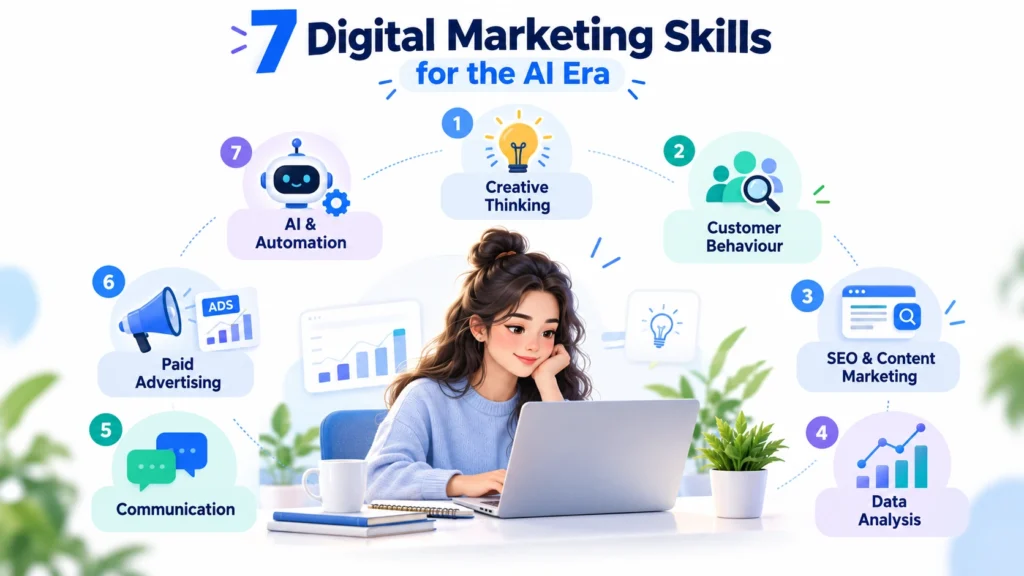
7 Digital Marketing Skills That Will Stay Valuable in the AI Era
AI tools will continue to improve, but several marketing skills remain useful because they involve judgment, problem-solving, and understanding people.
1. Creative Thinking
Creativity is not just about making attractive posters or writing catchy captions.
It involves finding fresh ways to communicate a message and attract the right audience.
AI can suggest ideas, but a marketer must identify which ideas fit a business and its customers.
For example, a creative campaign for a local bakery may focus on family celebrations, regional festivals, or customer stories rather than generic promotional content.
2. Understanding Customer Behaviour
Good marketing starts with understanding people.
Why does someone choose one brand over another? What makes a customer trust a business? Why do some people enquire but never purchase?
AI can organise research and identify patterns, but marketers also need to listen to customers and understand their concerns.
This skill is especially useful for businesses that depend on personal relationships and local trust.
3. SEO and Content Marketing
Search Engine Optimization, or SEO, is the process of improving a website’s visibility in search engines such as Google.
AI can help marketers research topics, create outlines, and prepare content drafts.
However, useful SEO content also needs accurate information, clear answers, and an understanding of what people are searching for.
Google’s guidance on AI-generated content makes it clear that producing large amounts of content without adding value can violate its spam policies.
This means good content marketers need more than AI writing skills.
They must know how to research, edit, verify information, and create content that helps real readers.
4. Marketing Data Analysis
Digital marketing campaigns generate information about website visits, clicks, enquiries, and sales.
AI can help organise these numbers, but someone must understand what they mean.
Imagine an advertisement receives hundreds of clicks but very few enquiries.
A marketer should investigate whether the issue is the audience, advertisement message, website experience, or offer.
Understanding data helps businesses make better marketing decisions.
5. Communication and Storytelling
Businesses need people who can communicate clearly with customers, clients, and team members.
AI can generate replies and messages, but it may not fully understand emotions, cultural differences, or sensitive situations.
Good communication helps build trust and explain the value of a product or service.
For beginners, writing clearly, listening carefully, and presenting ideas confidently are useful skills to develop.
6. Paid Advertising and Marketing Strategy
Platforms such as Google Ads and Meta Ads help businesses reach potential customers.
AI can assist with parts of advertising, but marketers still need to understand campaign goals, budgets, and performance.
A business may want more sales, enquiries, bookings, or store visits.
Choosing the right approach requires planning and analysis rather than simply publishing an advertisement.
7. AI Tools and Automation
AI literacy means understanding how AI tools work, what they can help with, and where they may make mistakes.
For digital marketers, tools such as ChatGPT, Canva, Google Analytics, Google Ads, and Meta Ads Manager can support different parts of their work.
Students do not need to learn every tool immediately.
It is better to understand a few tools properly and practise using them for real marketing tasks.
The most important skill is knowing when to use AI, when to check its output, and when human judgment is necessary.
AI Skills vs Human Marketing Skills: What Is the Difference?
The following comparison shows how AI and human marketing abilities can work together.
Marketing activity | What AI can help with | What marketers still need to do |
Social media | Captions and content ideas | Understand the audience |
SEO | Topic suggestions and drafts | Check quality and search intent |
Advertising | Ad variations and reports | Set goals and manage budgets |
Customer research | Summarise responses | Understand customer needs |
Content creation | Generate text and visuals | Add originality and brand identity |
Data analysis | Identify patterns | Make business decisions |
Customer communication | Draft messages | Build trust and solve problems |
Comparison prepared in October 2026. The division of work will continue to change as AI improves.
The important lesson is that AI tools and marketing knowledge should support each other.
A person who understands both can approach problems more effectively than someone who only knows how to generate content.
Can Plus Two Students and Graduates Build a Career in AI-Powered Digital Marketing?
Digital marketing is a field that students from different educational backgrounds can explore.
You do not need to be a programmer to start learning many of its core skills.
For Plus Two Students
After completing Plus Two, students often face questions about higher education and career choices.
Digital marketing can be explored alongside degree studies or as part of a wider skill-development plan.
Beginners can start with social media marketing, basic SEO, content writing, AI tools, and simple marketing projects.
For example, a student could create a sample social media campaign for a fictional café or clothing store.
This helps develop practical skills without needing previous work experience.
For Degree Graduates
A degree provides academic knowledge, but employers may also want evidence that a candidate can complete practical tasks.
Digital marketing allows graduates to apply abilities developed through different subjects.
Commerce graduates may enjoy advertising budgets and analytics. Arts graduates may prefer content creation and communication. Technical graduates may be interested in SEO, websites, and data analysis.
Students can select an area that matches their interests and develop a portfolio around it.
For Unemployed Job Seekers
People who are currently unemployed can also explore digital marketing as a possible career change.
Previous experience in sales, customer support, retail, or administration may be useful when learning how businesses communicate with customers.
Starting with free learning resources and small projects can help job seekers assess their interest before spending money on training.
Digital marketing offers different career paths, but employment is not guaranteed. Practical ability, communication, portfolio quality, and local job availability all affect opportunities.
How Can Beginners Start Learning AI-Powered Digital Marketing?
The best approach is to learn the fundamentals first and gradually add AI tools to your workflow.
A beginner can follow these steps.
Step 1: Understand the Basics of Marketing
Learn how businesses attract customers and promote products through websites, search engines, social media, and advertisements.
Focus on why marketing activities are used, not just how the tools work.
Step 2: Practise With AI Tools
Use an AI assistant to generate campaign ideas, draft captions, or organise content plans.
Then review and improve the output yourself.
For example, compare an AI-generated Instagram caption with one you write independently. Decide which better fits the target audience and explain why.
Step 3: Choose One Marketing Skill
Instead of trying to master everything at once, begin with one area such as SEO, social media marketing, content creation, or paid advertising.
Develop confidence through repeated practice.
Step 4: Build a Small Portfolio
A portfolio is a collection of projects that demonstrates your skills.
You can prepare sample advertisements, content calendars, website audits, or marketing reports.
Even without client experience, clearly labelled practice projects can help demonstrate how you think and work.
For more ideas, read this guide on practical digital marketing projects students can complete before applying for jobs.
Step 5: Explore Internships and Entry-Level Opportunities
Once you have basic knowledge and a few projects, explore suitable internships and trainee positions.
Possible roles include SEO trainee, social media assistant, junior content writer, digital marketing intern, and paid advertising assistant.
Use interviews to explain your projects, the tools you used, the challenges you faced, and what you learned.
Your Beginner Learning Checklist
- Learn marketing fundamentals and basic SEO.
- Practise using one AI assistant responsibly.
- Create sample social media content.
- Learn to read simple marketing reports.
- Complete a portfolio project.
Keep as proof: Your completed designs, drafts, project notes, and screenshots.
A Practical AI Marketing Example From Kerala
Imagine a small clothing shop in Malappuram wants to attract more customers through Instagram.
A beginner marketer could start by studying the shop’s products, audience, and competing businesses.
Next, the marketer could use AI to generate content ideas and prepare several caption variations.
However, instead of publishing everything immediately, the learner should review the captions for accuracy and local relevance.
The marketer could then prepare a sample content calendar and recommend ways to measure enquiries.
This exercise develops multiple skills: research, content creation, AI use, planning, and analysis.
It also teaches an important lesson.
Knowing how to use AI is helpful. Knowing why a marketing decision makes sense is more valuable.
This is an illustrative training example, not a claim about a completed business campaign.
Common Mistakes Beginners Should Avoid
Many beginners start learning AI tools with enthusiasm but overlook important marketing skills.
One mistake is believing that using ChatGPT or creating AI-generated content is enough to become a professional digital marketer.
Another is collecting certificates without building practical projects.
Some students also try to learn too many platforms at once, making it difficult to develop confidence in any one area.
Copying AI-generated content without checking it can lead to factual errors, poor communication, and loss of trust.
Beginners should also avoid uploading private customer information into AI tools without proper permission.
Before applying for jobs, use this simple checklist:
- Can I explain why I chose a marketing strategy?
- Have I checked the accuracy of my work?
- Can I show examples of completed projects?
- Can I explain what AI helped me do?
- Can I describe what I would improve next time?
Keep as proof: A portfolio with clear project descriptions and honest explanations of your contributions.
Students should understand that a certificate can support their application, but it cannot replace the ability to demonstrate relevant work.
For another perspective, read Is Digital Marketing Oversaturated in 2026? to understand why basic tool skills alone may not be enough in a competitive field.
What Career Opportunities Exist in AI-Powered Digital Marketing?
Learning digital marketing and AI tools can prepare students to explore several entry-level career paths.
These include social media marketing, SEO, content marketing, performance marketing, marketing analytics, and marketing automation.
Some beginners may also explore freelancing after developing reliable skills and a portfolio.
Different roles require different abilities.
A student who enjoys writing may prefer content marketing, while someone interested in numbers might explore advertising analytics.
A person who communicates confidently may enjoy client coordination or lead management.
In Kerala, practical knowledge of local businesses, Malayalam communication, and customer behaviour can be useful in marketing-related roles.
However, beginners should remember that competition exists, and each employer may have different eligibility requirements.
The best approach is to identify a suitable career direction and build skills that match it.
Frequently Asked Questions
❓Will AI replace digital marketing jobs in the future?
AI may automate some repetitive marketing tasks, especially basic content production and reporting. However, marketers who understand strategy, customers, creativity, and data can continue to provide useful skills. The exact impact will depend on how businesses adopt AI.
❓Can I learn AI-powered digital marketing after Plus Two?
Yes. Plus Two students can start learning digital marketing basics and AI tools without previous experience. Some employers may require a degree, so students should check job eligibility before choosing a career path.
❓Is digital marketing suitable for unemployed graduates?
Digital marketing is one option unemployed graduates can explore. Learning practical skills and building a portfolio may help with applications for internships and beginner roles, although it does not guarantee employment.
❓Do I need coding knowledge to learn AI-powered digital marketing?
Coding is not required for many entry-level digital marketing activities. Beginners can learn social media marketing, content creation, basic SEO, advertising, and analytics without advanced programming skills.
❓What are the most important AI marketing skills to learn?
Important skills include customer research, creative thinking, content writing, SEO, campaign planning, data analysis, communication, and responsible AI use. A combination of marketing knowledge and practical AI experience is more useful than tool knowledge alone.
❓Can beginners learn digital marketing without work experience?
Yes. Beginners can start with free resources, guided training, and practice projects. Building a portfolio helps demonstrate their abilities even when they have not yet worked for a client.
AI is changing digital marketing, and some tasks will become easier to automate.
But technology alone does not understand every customer’s needs, make every business decision, or guarantee successful marketing results.
For Plus Two students, degree graduates, and job seekers, the opportunity is to build practical marketing knowledge while learning how AI can support everyday work.
Focus on creativity, customer understanding, communication, data analysis, and continuous learning.
Start small, work on projects, and develop the confidence to explain your decisions.
At Dexta Academy, students can explore practical digital marketing and sales training that incorporates AI tools, projects, and career preparation.
Remember, the future is not simply about who knows how to use AI. It is about who knows how to use AI with purpose, skill, and good judgment.
Ready to Build Your AI Marketing Skills?
Learn AI-powered digital marketing through practical training and real-world projects with Dexta Academy.
Explore Digital Marketing Courses →About The Author

Raees Addox
Raees Addox is a digital marketing leader with 7+ years of industry experience, working at the intersection of digital marketing, sales, and AI. He is the Co-Founder of Addox Digital and Co-Founder & CEO of Dexta Academy.
0 Comment