

An Instagram advertisement catches someone’s attention. They check the business profile, search its name on Google, send a WhatsApp message and eventually make a purchase.
The business earns money.
But the advertising dashboard reports zero sales.
Where did the credit go?
This is the problem of ad attribution—and it is one of the most misunderstood parts of digital marketing.
The real issue is not always that advertisements fail. Sometimes, the tracking system simply cannot follow the full customer journey. In other cases, the ads receive credit for sales that might have happened anyway.
For aspiring digital marketers, especially Plus Two and degree graduates in Kerala, understanding this difference can turn basic advertising knowledge into a valuable business skill.
What Is Ad Attribution, and Why Does It Matter?
Ad attribution assigns credit to marketing interactions, but it does not automatically prove that an advertisement caused a sale.
Ad attribution is the process of identifying which marketing activities receive credit when a customer completes an action, such as submitting an enquiry or purchasing a product.
Imagine a customer who:
- Discovers a clothing brand through an Instagram Reel advertisement.
- Searches for the brand on Google.
- Visits its website to check prices.
- Contacts the seller on WhatsApp.
- Visits the shop and purchases an outfit.
Several channels influenced the buying journey. But the final sale may not appear under the original Instagram campaign.
Why?
Because each platform measures only the interactions and conversions it can observe or estimate.
This matters because businesses use attribution reports to decide where to spend their advertising budgets.
An incorrect interpretation could lead a business to stop a useful campaign or continue an ineffective one.
Where Does Sales Credit Actually Disappear?
Sales credit can disappear because a transaction was never recorded, could not be connected to an ad, or was credited elsewhere.
Instead of treating every missing conversion as one technical problem, it helps to separate attribution gaps into four categories.
1. The Tracking Gap
The customer completes an action, but the tracking system does not record it correctly.
For example, someone submits a website enquiry form, but the form-submission event never fires.
The lead reaches the business, yet the dashboard records no conversion.
2. The Customer Journey Gap
The customer discovers the business online but completes the purchase through another channel.
This often happens when customers move from Instagram to WhatsApp, phone calls or physical shops.
The sale exists in business records but may not be connected to the advertisement.
3. The Attribution Rules Gap
The tracking system records the conversion, but a different channel receives credit.
For example, a customer discovers a business through paid social media and returns through Google Search before purchasing.
The reported credit depends on the attribution model and the interactions available to that system.
4. The Sales Follow-Up Gap
The advertisement produces a genuine enquiry, but the business fails to convert the customer.
Perhaps the salesperson responds late, forgets to follow up or cannot answer the customer’s questions.
This is not necessarily an attribution problem.
It may be a sales-process problem.
The important distinction: A missing sale, a missing conversion event and missing attribution credit are three different issues. Each requires a different solution.
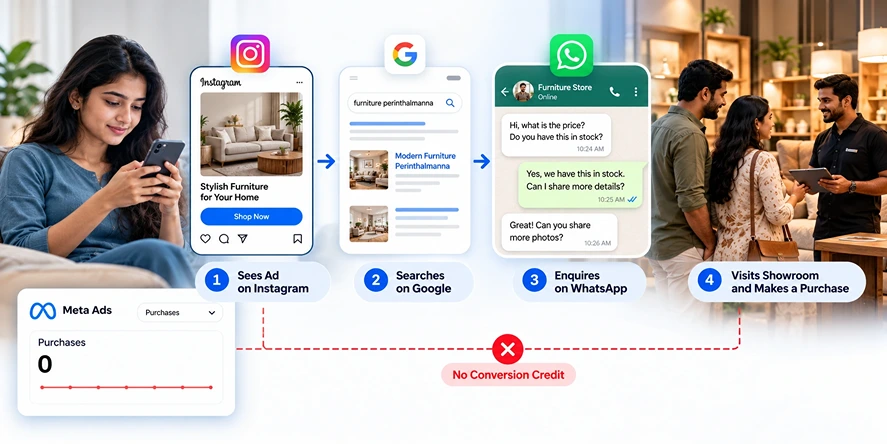
The Perinthalmanna Problem: When Sales Move to WhatsApp
For businesses that close sales through conversations, tracking only website actions can give an incomplete view of advertising performance.
Consider a hypothetical furniture business in Perinthalmanna.
It runs Instagram advertisements showcasing bedroom furniture and interior designs.
A potential customer watches the advertisement but does not purchase immediately.
Instead, they visit the Instagram profile, check photographs, ask about prices on WhatsApp and discuss delivery options.
After a few days, they visit the showroom with their family and place an order.
The business records the sale.
But the advertising platform may only have recorded the earlier clicks or messages.
This matters because products such as furniture, jewellery, courses and home-interior services often involve questions and discussions before purchase.
The customer may need reassurance about quality, cost, delivery or suitability.
Why WhatsApp clicks are not the same as sales
A marketer might report 50 WhatsApp button clicks.
But those clicks do not prove that 50 customers started meaningful conversations.
Some may never send a message. Others may only ask for prices. A smaller number may become genuine prospects.
That is why digital marketing measurement should follow a useful sequence:
Ad → Enquiry → Qualified Lead → Follow-Up → Customer → Sale
When reporting stops at the enquiry stage, the business sees only part of the result.
For beginners, understanding this journey is often more useful than memorising advertising dashboard settings.
Why Do Meta Ads and Google Analytics Show Different Conversions?
Meta Ads and Google Analytics can report different results because they use different measurement methods and attribution rules.
Imagine Meta Ads reports 12 purchases while Google Analytics 4 reports seven purchases credited to paid social.
That difference does not automatically mean either platform is incorrect.
There are several possible explanations.
Different attribution models: Platforms can assign credit to different eligible interactions.
Different conversion definitions: One report may count purchase events while another includes other important actions.
Different reporting windows: A purchase may happen after an earlier advertisement interaction, and its eligibility for credit depends on the configured rules.
Different data coverage: Browser settings, consent choices, device changes and missing tracking information can affect what each platform observes.
Different reporting dates: One system may organise results around ad interactions while another uses conversion-event dates.
Google Analytics 4 supports data-driven and last-click attribution options. Some older attribution models, including first-click and linear attribution, were discontinued from GA4 reporting in November 2023.
You can review these rules in Google’s official GA4 attribution documentation.
A mistake that makes reporting even worse
Some marketers add purchase tracking through the browser and a server connection without correctly handling duplicate events.
The result can be the opposite of missing credit: one real purchase may be recorded more than once.
Meta’s official learning material covers event matching, coverage and deduplication in its Conversions API training.
The lesson is simple: don’t assume that a larger conversion number is always more accurate.
How to Find Missing Sales Credit: The Five-Question Audit
The fastest way to investigate missing credit is to trace the business outcome backwards through the customer journey.
Here is a practical framework beginners can use before changing campaign budgets.
Question 1: Did a real sale happen?
Start with the business’s confirmed order or payment record, not the advertising dashboard.
Check the transaction date, order status and whether the sale was completed.
Question 2: Where did the customer first enquire?
Was it through a website form, Instagram message, WhatsApp conversation, telephone call or store visit?
Record the source if it is known, and label it unknown when it is not.
Question 3: Was the conversion event recorded?
If a website form was submitted, check whether the intended tracking event was triggered.
If a purchase occurred offline, determine whether the business has an approved way to record that outcome.
Question 4: Could the event be connected to an advertisement?
A recorded purchase is not necessarily an attributed purchase.
There must be enough eligible information and a suitable measurement setup to make the connection.
Question 5: What does the evidence actually prove?
Separate confirmed facts from assumptions.
You may know that the customer purchased after seeing an ad. You may not know whether they would have purchased without it.
This final question protects marketers from making claims their data cannot support.
Case Study: A Campaign That Looked Like a Failure
Comparing advertising reports with sales records can reveal a measurement gap, but the comparison alone cannot prove advertising impact.
Imagine a footwear shop in Perinthalmanna running a promotional Instagram campaign.
The campaign performs reasonably well at attracting interest, but the advertising dashboard reports very few purchases.
The owner believes the campaign failed.
The marketer checks the shop’s enquiry and order records.
Illustrative campaign results
The figures below are fictional examples for learning, not actual campaign results or local benchmarks.
Metric | Value | Period |
Advertising spend | ₹8,000 | 1–14 October 2026 |
Recorded enquiries | 40 | 1–14 October 2026 |
Qualified enquiries | 16 | 1–14 October 2026 |
Confirmed purchases from those enquiries | 6 | 1–14 October 2026 |
Recorded revenue from those purchases | ₹24,000 | 1–14 October 2026 |
Purchases attributed by the ad dashboard | 1 | 1–14 October 2026 |
At first, the advertising dashboard suggests a disappointing outcome.
But the business records show six completed purchases from the enquiries reviewed.
What can we conclude?
The difference deserves investigation. Perhaps purchases happened offline, some source information was lost, or the tracking setup did not capture the final transactions.
What can’t we conclude?
We cannot automatically say that the advertisement caused all six purchases.
The customer records may help establish a connection, but stronger evidence is needed to prove additional sales caused by advertising.
What should the marketer do next?
First, test the conversion setup. Then review the enquiry sources and purchase records. Finally, present the findings with a clear explanation of what is confirmed and what remains uncertain.
This is a more useful client conversation than simply saying, “Meta is not tracking properly.”
Attribution vs Incrementality: The Difference Most Beginners Miss
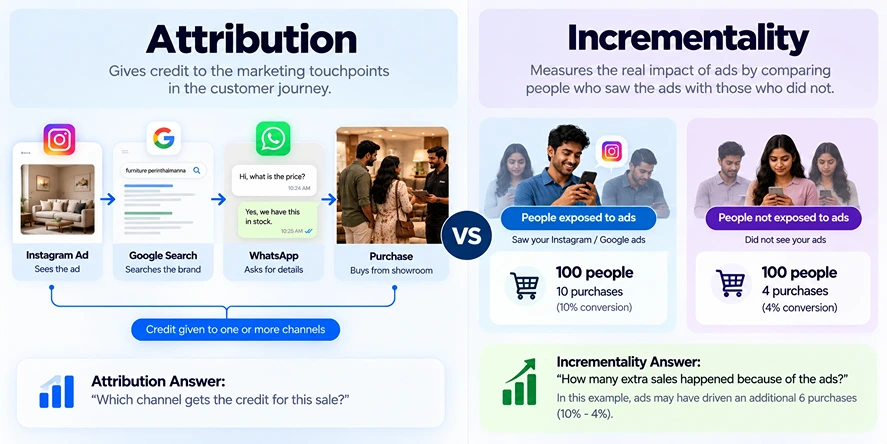
Attribution explains who receives conversion credit; incrementality estimates what additional results advertising actually caused.
Suppose a shop runs an advertisement during a busy festival-shopping period.
Its sales increase.
Did the ad cause the increase?
Maybe. But sales could also rise because of seasonal demand, repeat customers, referrals or an attractive discount.
This is where incrementality becomes important.
Incrementality asks what would have happened without the advertising.
A properly designed controlled experiment compares outcomes between groups exposed to advertising and suitable groups that are not.
Google explains this approach in its Conversion Lift documentation.
For small local businesses, such studies may require more data and budget than they can reasonably provide.
That does not make basic tracking useless. It means the business should use the strongest evidence realistically available and avoid claiming more certainty than the data supports.
Unpopular truth: An ad platform can accurately report an attributed conversion without proving that the advertisement created an additional customer.
How Can Businesses Improve Ad Attribution?
Better measurement combines reliable technical tracking with clear enquiry records and consistent sales follow-up.
For businesses with limited resources, improvement should begin with basic measurement rather than expensive software.
- Define what counts as success
A website visit, WhatsApp click, completed enquiry and confirmed purchase are different actions.
Choose the important outcomes for the business and report them separately.
- Add UTM campaign parameters
UTM parameters are labels added to website links to identify traffic sources and campaigns.
These labels can help identify campaign traffic in analytics reports.
Google explains how to use them in its campaign URL tracking guide.
However, UTM parameters alone do not connect every later offline purchase to an ad.
- Test conversion events
Make sure a form-submission event fires after a successful submission, not merely when someone opens the form.
Check that purchases are recorded accurately and not counted twice.
Students unfamiliar with the tools can start with this beginner’s guide to Meta Pixel, Google Tag Manager and GA4.
- Maintain a simple lead-status sheet
A business can begin with a spreadsheet recording the enquiry date, broad source, lead status and final outcome.
Avoid collecting unnecessary personal information, and protect any customer data that is legitimately required.
- Connect sales outcomes to campaigns where possible
For businesses with suitable systems, Google Ads provides enhanced conversions for leads to help connect eligible offline outcomes with previous advertising interactions.
Google’s current enhanced conversions documentation explains this process.
Which Attribution Fixes Should You Prioritise?
Fix unreliable events and disconnected sales records before paying for more advanced measurement technology.
Not every business needs the same setup.
A small boutique with occasional enquiries has different needs from an online retailer processing hundreds of orders.
Improvement | Relative effort | Main benefit |
Test website conversion events | Low–medium | Identify missing or incorrect events |
Standardise campaign links | Low | Improve traffic-source reporting |
Maintain an enquiry-status sheet | Low | Connect conversations with outcomes |
Connect a customer-management system | Medium–high | Improve lead-to-sale visibility |
Add approved server-side tracking | High | Improve eligible event coverage |
Run a controlled lift experiment | High | Estimate incremental ad impact |
Qualitative effort comparison, October 2026. Actual costs depend on business size, tools and implementation.
For a small business, the best first investment may be a consistent lead record and better follow-up.
For a larger business, automation may reduce manual work and improve reporting.
The strongest solution is not always the most expensive.
Why Marketing and Sales Skills Belong Together
A marketer who understands sales can diagnose whether results are lost in tracking, customer qualification or follow-up.
The attribution problem reveals something important about digital marketing careers.
Learning how to launch Meta Ads or Google Ads is useful. But businesses also need marketers who understand what happens after the click.
For example, a campaign may generate 30 enquiries. If only two become customers, a marketer should investigate the quality of those leads and the way they were handled.
Were the customers in the correct location? Did the advertisement set realistic expectations? Did the salesperson respond promptly? Was the offer suitable?
These questions require both marketing and sales knowledge.
At Dexta Academy, the approach is expressed through the idea: “We teach you how to market and sell – so you get better jobs, clients, or start your own thing.”
For Plus Two and degree graduates in Perinthalmanna, an attribution project is one way to practise this connection.
Rather than simply showing an ad design in a portfolio, a student can explain the customer journey, identify where measurement might fail and recommend sensible improvements.
That kind of analytical work can help a fresher demonstrate practical thinking.
For related career context, read whether digital marketing is oversaturated in 2026.
How Can a Student Build an Attribution Portfolio Project?
A portfolio project becomes more valuable when it explains a business problem, the evidence available and the limits of the conclusion.
You do not need access to a real advertising budget to begin learning attribution.
Checklist 1: Create a campaign-tracking simulation
- Choose a fictional local business, such as a boutique or tuition centre.
- Draw the journey from advertisement to enquiry and sale.
- Create an example campaign URL with UTM parameters.
- Prepare a spreadsheet of enquiries and outcomes.
- Identify where conversion information might be lost.
Proof to keep: A customer-journey diagram and a sample campaign tracking sheet.
Checklist 2: Prepare an attribution audit
- Compare a fictional dashboard with a sales record.
- Highlight missing or duplicate conversions.
- List possible explanations.
- Recommend three practical checks.
- Explain what the available data cannot prove.
Proof to keep: A short case-study presentation with dated, clearly labelled sample data.
Common Attribution Mistakes to Avoid
Mistake 1: Treating clicks as customers. A click shows interest or interaction. It does not confirm a sale.
Mistake 2: Counting every WhatsApp interaction as a lead. Opening a chat link and starting a genuine enquiry are not always the same thing.
Mistake 3: Giving advertisements credit for every sale. Repeat customers and referrals can purchase during a campaign without being caused by it.
Mistake 4: Comparing unlike reports. Always check date ranges, attribution rules and conversion definitions.
Mistake 5: Ignoring sales follow-up. Better attribution cannot repair poor customer service or an unsuitable offer.
Mistake 6: Trusting high return on ad spend without context. Attributed revenue is not profit, and missing or duplicate conversions can distort the calculation.
To understand how campaign performance metrics connect, see this guide to CTR, CPC, CPL, CPA and ROAS.
Myth vs Fact
Myth: A dashboard showing zero purchases proves that an advertisement failed.
Fact: The campaign may have failed, the sales may be outside the tracking system, or the reporting rules may assign credit elsewhere.
Myth: Better tracking guarantees perfect attribution.
Fact: Better tracking can reduce measurement gaps, but customer behaviour, privacy rules and attribution models still create limits.
Frequently Asked Questions
❓What is attribution in digital marketing?
Attribution is the method used to give marketing interactions credit for customer actions such as enquiries and purchases. Different systems may assign credit differently depending on the available data and reporting rules.
❓Why do my Facebook or Instagram ads show no sales?
Possible reasons include incomplete tracking, offline sales, WhatsApp purchases, incorrect conversion settings or customers buying through another channel. The campaign may also have genuinely produced no purchases.
❓Can Google Analytics 4 track offline purchases?
GA4 mainly measures events collected through configured websites, apps and other supported data integrations. Offline outcomes require suitable additional collection or integration methods; they do not appear automatically.
❓Can WhatsApp sales be connected to advertisements?
In some cases, yes. Suitable campaign links, approved integrations and authorised sales records can help connect enquiries with advertising activity. The ability to attribute final purchases depends on the measurement setup and available information.
❓What is the difference between conversion tracking and attribution?
Conversion tracking records an action, such as a form submission or purchase. Attribution determines which eligible marketing interactions receive credit for that recorded action.
❓What is the difference between attribution and incrementality?
Attribution distributes conversion credit using available information. Incrementality attempts to estimate how many additional actions happened because advertising was shown.
❓Is attribution worth learning for digital marketing beginners?
Yes. It helps students understand campaign reporting, customer journeys and sales performance. A simple attribution audit can also become a useful portfolio exercise.
Attribution isn’t completely broken. But treating an advertising dashboard as a perfect record of business performance is a mistake.
Customers don’t always purchase immediately after clicking an advertisement. They compare options, ask questions, switch platforms, speak with salespeople and sometimes buy offline.
Every change of channel can create a measurement gap.
The solution isn’t simply adding more tracking tools. It is learning to connect advertising activity with real enquiries, qualified customers and confirmed sales.
For aspiring digital marketers in Kerala, this is an important skill to develop.
Because the best marketers don’t merely report how many people clicked an advertisement.
Go Beyond Clicks. Learn to Drive Real Sales.
Learn practical digital marketing and sales skills at Dexta Academy, Perinthalmanna. Build the confidence to start your career, freelance, or grow your own business.
Start Your Digital Marketing Journey ↗About The Author

Raees Addox
Raees Addox is a digital marketing leader with 7+ years of industry experience, working at the intersection of digital marketing, sales, and AI. He is the Co-Founder of Addox Digital and Co-Founder & CEO of Dexta Academy.
0 Comment