

Imagine walking into a job interview without years of experience, but with something more interesting to show: your own marketing projects, creative work, and online portfolio.
That’s what personal branding for marketers can help you achieve.
For Plus Two students and degree graduates, finding a first job can be challenging. You may have qualifications and basic skills, but how do you convince employers to give you an opportunity?
The answer is to show what you can do, not just tell employers what you’ve studied.
Let’s explore how to build a personal brand that helps your skills get noticed.
What Is Personal Branding for Marketers?
Personal branding helps beginners communicate their skills and professional interests through visible examples of their work.
Personal branding is the way people recognise your skills, interests, and professional abilities.
For example, when someone searches your name online, what would you like them to discover?
It could be your LinkedIn profile, marketing projects, content designs, or a portfolio of work.
As a beginner marketer, your personal brand might highlight your interest in social media marketing, content creation, search engine optimization (SEO), or advertising.
You don’t need thousands of followers or an expensive website to begin.
A strong personal brand starts with genuine skills and clear proof of your work.
Why Is Personal Branding Important for Freshers?
Showing practical work can give employers stronger evidence of your abilities than listing skills alone.
Many freshers face the same problem: employers want experience, but students need opportunities to gain it.
Personal branding helps bridge this gap.
According to the National Association of Colleges and Employers’ 2026 research, 70% of participating US employers reported using skills-based hiring.
Although this finding is not specific to India, it highlights the importance of showing practical abilities.
For example, a degree graduate in Malappuram could prepare a sample Instagram campaign for a clothing store.
Even without professional experience, the student can demonstrate content planning, customer understanding, and creative thinking.
That’s far more useful than simply writing “social media marketing skills” on a resume.
Can You Really Get Hired Without a Resume?
A portfolio can attract job opportunities, but it does not remove the need for a resume in every hiring process.
Yes, it’s possible to attract job opportunities without initially submitting a resume.
Imagine a recruiter discovering your LinkedIn post explaining a marketing project. They visit your profile, review your portfolio, and contact you about an internship.
Your work has already introduced you.
Similarly, a local business owner might notice your content or marketing analysis and invite you to discuss a freelance assignment.
However, many companies still require resumes and formal applications.
The smarter approach is to make your portfolio and personal brand support your resume.
Your resume explains your qualifications. Your portfolio demonstrates your skills.
Together, they help employers understand what you can contribute.
How to Build Your Personal Brand as a Beginner
Choosing one marketing skill and practising it through projects is a practical starting point for building a professional identity.
Building a personal brand doesn’t need to be complicated. Follow these four steps.
Step 1: Identify Your Strengths
Ask yourself what interests you most.
Do you enjoy writing, graphic design, social media, analysing information, or creating videos?
Choose one area to start with rather than trying to learn everything at once.
Step 2: Learn the Basics
You can begin with free learning resources, including HubSpot Academy’s social media marketing course.
Focus on understanding the concepts and applying them to practical work.
Step 3: Create and Document Projects
Build projects based on the skill you’re learning.
Keep your designs, reports, research, and creative ideas in an organised folder or online portfolio.
Step 4: Share Your Learning
Explain what you created, why you made certain decisions, and what you learned.
You don’t have to pretend to be an expert. Showing honest progress can be valuable.
How to Create a Marketing Portfolio Without Experience
A beginner portfolio should demonstrate problem-solving, creative decisions, and lessons learned, even when projects are simulations.
A marketing portfolio is a collection of projects that demonstrates your practical abilities.
You don’t need paying clients to create your first portfolio.
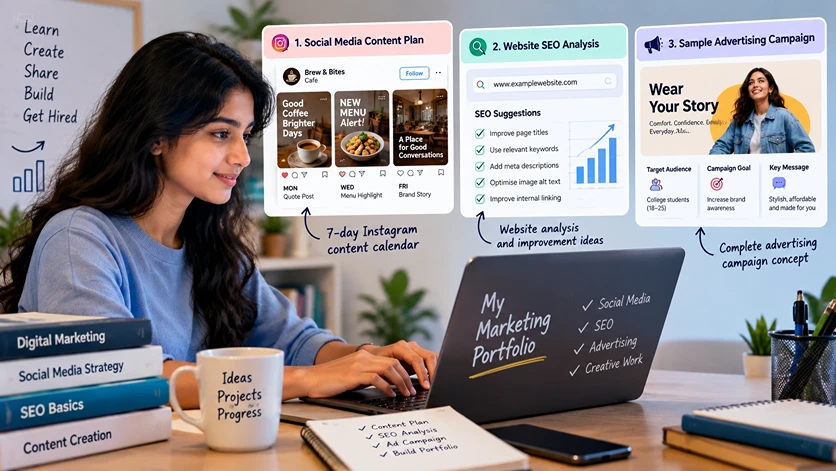
Here are three projects students can try:
Project 1: Social Media Content Plan
Choose a fictional café or clothing brand. Create a seven-day Instagram content calendar, including sample designs and captions.
Project 2: Website SEO Analysis
Study a public website and suggest improvements to its headings, content, and page titles. SEO helps websites become more visible in search results.
Project 3: Sample Advertising Campaign
Create an advertising concept with a target audience, campaign goal, message, and sample creative.
Clearly identify practice projects as simulations. Never invent advertising results or claim that you worked for a company without permission.
For more ideas, explore practical digital marketing projects students can complete before applying for jobs.
Portfolio tip: For every project, explain the problem, your approach, the completed work, and what you would improve.
How Can LinkedIn Help You Attract Recruiters?
A clear LinkedIn profile with relevant projects can help recruiters understand a beginner’s interests and abilities.
LinkedIn is a professional networking platform where students can discover career opportunities, connect with industry professionals, and display their work.
Start with a clear headline.
Instead of simply writing “Student,” try:
“Aspiring Digital Marketer | Content Creation | Social Media Marketing Learner”
Next, write a short introduction about your interests, education, and projects.
Add examples of your work using LinkedIn’s Projects section. Its official guide explains how to add project descriptions and supporting media.
You can also share educational posts or reflections about your learning.
If you have completed Plus Two, check LinkedIn’s age requirements before creating an account. Younger students can begin with a private portfolio until eligible.
Remember, LinkedIn is a place to demonstrate your abilities and build relationships, not just collect connections.
How Can You Turn Personal Branding Into Job Opportunities?
A clear portfolio, relevant connections, and respectful outreach can help students start conversations about internships and entry-level opportunities.
Building a profile is only the beginning. You also need to connect your work with career opportunities.
Start by researching marketing agencies and businesses that hire freshers.
Read their job descriptions to understand which skills they need.
Then select one relevant portfolio project and introduce yourself professionally.
For example:
“Hello, I’m a recent graduate interested in social media marketing. I’ve created a sample content strategy and would appreciate your feedback if you have time to review it.”
This approach gives the other person a reason to look at your work.
You can also attend career workshops, connect with mentors, and explore internships.
Marketing is a competitive field. Read more about why practical skills matter in today’s digital marketing job market.
Avoid sending the same message repeatedly to recruiters. Meaningful professional relationships take time.
Common Personal Branding Mistakes to Avoid
Authentic work and honest communication build more credibility than copied projects or exaggerated achievements.
Beginners sometimes think personal branding means becoming popular on social media.
But popularity and professional credibility are not the same.
Avoid these common mistakes:
- Copying other people’s projects: Create your own examples and explain your decisions.
- Focusing only on followers: Relevant skills and quality projects matter more.
- Claiming fake experience: Be clear about practice projects and internships.
- Posting without a purpose: Share content connected to your career interests.
- Expecting instant results: Professional relationships and skills develop over time.
Myth: You need thousands of followers to get a marketing job.
Fact: A small but relevant portfolio may help an employer evaluate your abilities, even if your following is limited.
Practical Example: A Student Building a Personal Brand in Kerala
Local marketing projects allow students to demonstrate how they understand customers, language, and business needs.
Consider this illustrative example.
A degree graduate from Perinthalmanna wants to start a career in social media marketing.
Instead of applying for jobs with only a certificate, the student creates a sample campaign for a fictional bakery.
The project includes five Instagram post designs, a weekly content calendar, and Malayalam and English captions.
The student asks a few classmates for feedback, improves the designs, and prepares a short explanation of the work.
Finally, the student adds the project to a portfolio.
There are no fabricated sales or engagement statistics.
Even so, the project gives a recruiter something useful to discuss during an interview.
This illustrates an important point: you can start developing professional evidence before receiving your first job offer.
Your 30-Day Personal Branding Action Plan
A four-week project plan can help students create an initial portfolio and begin professional networking.
You don’t need to achieve everything in one day.
Use this simple plan to begin.
Timeline | Suggested activity | Expected outcome |
Week 1 | Identify your skills and career interests | Clear professional direction |
Week 2 | Build your first marketing project | Portfolio sample |
Week 3 | Create another project and improve your profile | Stronger work collection |
Week 4 | Share your portfolio and contact relevant professionals | Feedback and career conversations |
Illustrative four-week plan prepared in October 2026. Employment outcomes are not guaranteed.
Checklist 1: Portfolio preparation
- Choose a marketing skill.
- Complete two original practice projects.
- Record the purpose and process of each project.
- Ask for feedback and improve your work.
Checklist 2: Career preparation
- Prepare a professional introduction.
- Create an age-appropriate online profile.
- Keep a one-page resume ready.
- Practise explaining your portfolio.
- Research relevant internships and job openings.
Frequently Asked Questions
❓Can Plus Two students start personal branding?
Yes. Plus Two students can begin learning content writing, social media marketing, and basic design. They can create practice projects while following online platform age requirements.
❓Do I need a degree to become a digital marketer?
Not every digital marketing role requires a specific degree. However, requirements vary by employer. Practical skills, communication, and a portfolio can strengthen your application.
❓Is LinkedIn necessary to get a marketing job?
No. LinkedIn can help with networking, but you can also find opportunities through internships, college placements, referrals, and direct applications.
❓Can a portfolio replace a resume?
A portfolio can help you attract attention, but many employers still request resumes. Keeping both ready is the most practical option.
❓How long does personal branding take?
You can create an initial portfolio in a few weeks. Building trust, improving your skills, and attracting professional opportunities usually takes longer.
❓Do I need to spend money to start personal branding?
Not necessarily. You can begin with free learning resources, basic creative tools, and practice projects. Paid courses may offer structured guidance, but you should compare their content and cost.
You don’t need years of experience to begin building your professional identity.
For Plus Two students and degree graduates, personal branding offers a practical way to demonstrate skills, express creativity, and begin professional conversations.
Start with one skill. Build useful projects. Share your learning. Keep improving.
Students looking for guided digital marketing learning and project practice can explore the digital marketing course in Kerala offered by Dexta Academy. Check current course details and internship conditions before enrolling.
Remember, a strong personal brand cannot guarantee employment, but it can help employers understand your abilities.
Your resume tells your story. Your personal brand gives people something to see.
Ready to Build Your Personal Brand and Start Your Marketing Career?
Don't just list your skills on a resume—learn how to demonstrate them through real projects. Whether you're a Plus Two student or a degree graduate, take your first step toward a career in digital marketing with DEXTA Academy.
Explore Our Digital Marketing Course →About The Author

Raees Addox
Raees Addox is a digital marketing leader with 7+ years of industry experience, working at the intersection of digital marketing, sales, and AI. He is the Co-Founder of Addox Digital and Co-Founder & CEO of Dexta Academy.
0 Comment