

A local business can spend ₹1 lakh a month on Meta Ads or Google Ads, generate hundreds of enquiries, and still struggle to produce consistent sales.
The problem often appears after the lead is generated.
Marketing brings the enquiry in. Sales has to respond, understand the requirement, judge intent, follow up, and record what happened.
That handoff is where many local businesses, academies, clinics, agencies, and service companies lose revenue.
A Meta lead may enter WhatsApp at 11:20 AM. One salesperson replies immediately, another waits until evening, and a third sends the full price list before understanding what the customer needs.
By the next day, newer chats have pushed the enquiry down the screen.
This is the WhatsApp Black Hole: leads are generated, conversations happen, but there is no reliable system for knowing which prospects are serious or what should happen next.
To qualify digital marketing leads effectively, businesses need two connected layers:
WhatsApp manages the conversation. CRM manages the sales process.
The goal is not to make sales robotic. It is to make sure serious enquiries do not disappear because the team forgot what happened.
The Lead-to-Sale Gap Most Campaign Reports Miss
A campaign report usually starts with spend, impressions, clicks, leads, and cost per lead.
Sales needs a different view:
Lead → Contacted → Qualified → Follow-Up → Meeting → Customer → Revenue
Suppose Meta Ads generates 200 leads at an attractive CPL. If the CRM shows that only 20 were genuinely qualified and four became customers, that tells management much more than the original lead count.
Google Ads may generate fewer enquiries at a higher CPL but produce more high-intent prospects.
The right question is not simply, “How many leads did we generate?”
It is:
“How many of those leads were actually worth pursuing, and how many created revenue?”
Key Warning
If the marketing team reports 200 leads but the CRM cannot show how many became qualified, the business still does not know whether the campaign produced valuable opportunities.
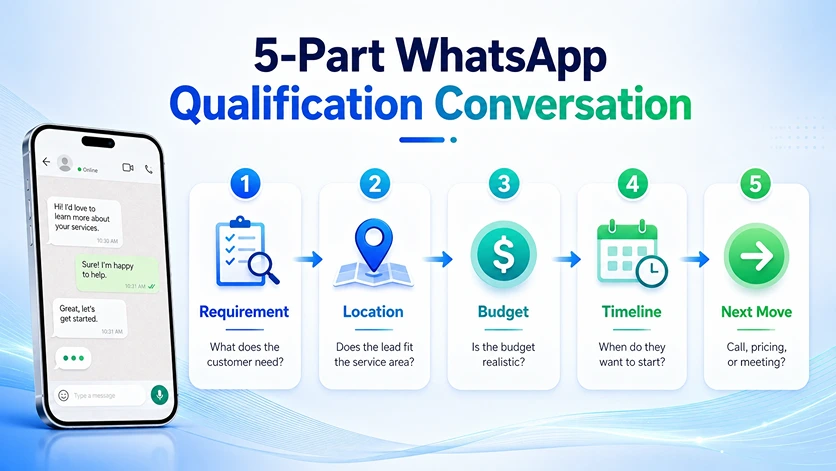
The 5-Part WhatsApp Qualification Conversation
Good qualification should feel like a natural conversation.
Do not send five questions in one message. Use each answer to decide what to ask next.
Requirement: Find the Real Problem First
Why it matters: The enquiry label rarely tells the full story.
Someone who asks for “digital marketing” may need Meta Ads, Google Ads, social media management, SEO, or simply a better way to generate enquiries.
A weak response is to immediately send every service, package, brochure, and price.
That forces the prospect to make sense of your offer before you understand the problem.
B2B variation:
“Thanks for reaching out. What are you mainly trying to improve right now—lead generation, sales, traffic, or something else?”
B2C / local service variation:
“Thanks for contacting us. Which service are you mainly looking for help with?”
Better strategy: Diagnose first. Recommend second.
Location: Check Whether the Lead Actually Fits
Why it matters: Location can determine serviceability, branch assignment, language, delivery, or offline attendance.
For an academy, a student may want an offline batch but live too far away. A local service business may be attracting leads from areas it cannot serve.
A bad response is spending several messages selling before discovering the prospect is outside the service area.
B2B variation:
“Which city is your business based in, and which locations are you trying to target?”
B2C / local service variation:
“Which location are you enquiring from?”
This field also becomes useful later when the CRM compares lead quality by city, branch, or territory.
Budget: Understand Commercial Fit Without Killing the Conversation
Why it matters: Budget helps the salesperson decide which option is realistic.
The mistake is asking, “What is your budget?” too early or reacting immediately when the amount sounds low.
Some buyers have not set a budget yet. Others are trying to understand the market before deciding.
B2B variation:
“Have you already set a budget range for this, or are you still evaluating what would be realistic?”
B2C / local service variation:
“Do you already have a budget range in mind, or would you like us to suggest suitable options?”
Key Warning: Sending pricing before understanding requirement and fit can shift the buyer’s attention from value to price comparison too early.
Timeline: Separate Immediate Intent From Future Interest
Why it matters: Timing changes sales priority.
A prospect looking to start this week should not receive the same follow-up rhythm as someone planning to buy three months later.
The bad response is treating “later” as a dead lead.
That prospect may simply belong in nurture.
B2B variation:
“Are you looking to start immediately, this month, or later in the quarter?”
B2C / local service variation:
“When are you planning to get started?”
The answer should become a CRM field, not disappear inside the WhatsApp chat.
Next Move: Turn Interest Into a Clear Action
Why it matters: Desired next step is one of the clearest buying-intent signals.
A prospect requesting a call, quotation, demo, or appointment is behaving differently from someone who only says, “Send details.”
A weak sales conversation ends after information is sent.
A strong one ends with a next step.
B2B variation:
“Would you prefer a short call, a proposal first, or a meeting to discuss the requirement?”
B2C / local service variation:
“Would you like to see pricing first, speak over a quick call, or book an appointment?”
Pro Tip
Qualification should reduce uncertainty. By the end of the conversation, the salesperson should know whether the lead deserves immediate attention, follow-up, or nurture.
The Signal Stack: A Simple Lead Scoring Framework
Once the five qualification signals are known, a simple score can help sales teams prioritise.
This is an example framework, not an industry benchmark.
Qualification Signal | Score |
Clear requirement | +2 |
Correct location / service fit | +2 |
Suitable budget | +2 |
Purchase planned within 30 days | +2 |
Requests a call or meeting | +2 |
8–10: High Priority
5–7: Medium Priority
0–4: Low Priority / Nurture
The model should improve as real sales data accumulates.
If medium-priority leads regularly convert better than high-priority leads, your scoring logic needs adjustment.
The CRM Architecture Behind Better Follow-Up
WhatsApp tells you what the prospect said.
The CRM should tell the business what that information means.
Lead Source and Campaign Source
Track whether the lead came from Meta Ads, Google Ads, organic search, referral, website, or another channel.
Then record the campaign or ad source where possible.
This lets marketing compare lead quality, not just volume.
It also makes segmentation easier. A business can separate Google Ads leads from Meta Ads leads for reporting, nurturing, or retargeting workflows where appropriate and permitted.
Assigned Owner
Every lead should have one person responsible for moving it forward.
Without ownership, leads often become “someone’s job” and therefore nobody’s job.
CRM Stage
Stages should show where the prospect currently sits.
A clean structure is:
New Enquiry → Contacted → Follow-Up → Qualified → Appointment / Meeting → Converted
Use Negative when the enquiry never became a realistic opportunity.
Use Lost when it was a real opportunity but did not convert.
Key Takeaway
Negative = poor or unsuitable opportunity.
Lost = genuine opportunity that sales failed to convert.
That distinction matters for performance reporting.
Too many Negative leads may point to targeting problems. Too many Lost leads may indicate sales, pricing, offer, or competitor issues.
Requirement, Location, Budget, and Timeline
These properties make segmentation possible.
A business can later compare which service generates better conversion, which locations perform best, which budget bands convert, or whether immediate buyers close faster than long-term enquiries.
They also help future campaigns.
For example, a CRM segment of interested prospects who were delayed by timing can be used for later nurture or retargeting, subject to consent and platform rules.
Lead Score
Store the score inside the CRM rather than leaving it in the salesperson’s head.
Managers can then filter high-priority opportunities and compare scoring with actual conversion performance.
Last Contact and Next Follow-Up
These fields prevent the WhatsApp Black Hole.
A lead marked “Follow-Up” without a follow-up date is not really being managed.
The CRM should make it obvious what happened last and what happens next.
Lost Reason and Revenue
Lost reasons create learning.
Track reasons such as price, competitor, timing, no response, or requirement change.
Revenue closes the loop.
Once revenue is connected to source and campaign, marketing can move from lead reporting to business reporting.
The Follow-Up Cadence: A 14-Day Execution Rhythm
Follow-up should not mean sending “Any update?” every few days.
Every message needs a purpose.
Timing | Purpose | Sales Goal |
Immediate | Acknowledge enquiry | Start conversation |
Same business day | Second attempt | Establish contact |
Day 1 | Clarify | Surface questions |
Day 3 | Add relevant proof | Reduce uncertainty |
Day 7 | Confirm intent | Get decision signal |
Day 14+ | Reactivate or close | Clean the pipeline |
Immediate Response
Auto-response:
“Thanks for contacting us. We’ve received your enquiry and someone from our team will respond shortly. Meanwhile, which service are you interested in?”
The auto-response should open the conversation, not dump brochures or pricing.
Day 1
Clarification follow-up:
“Hi Arun, did you get a chance to review the details? I can clarify the pricing, timeline, or package if anything is unclear.”
Day 3
Proof-based follow-up:
“You mentioned lead quality was the main concern. I can share a similar example and explain what was done differently. Would that be useful?”
Day 7
Intent check:
“Hi Arun, are you still planning to move forward with this, or has the requirement changed?”
Day 14+
Reactivation:
“Hi Arun, checking back on your earlier enquiry. Is this still something you’re considering, or would you prefer that I close it for now?”
Pro Tip
Follow up to move the decision forward—not because a calendar reminder told you to send another message.
Real-World WhatsApp Battle-Testing
The Prospect Reads but Does Not Reply
Do not immediately send another “Hi.”
Give them something concrete to respond to.
“Hi Arun, just checking whether the main concern is pricing, timing, or the service itself. Happy to clarify whichever part is holding things up.”
“Your Price Is Too High”
Do not immediately discount.
First identify what “too high” means.
“Understood. Is the concern mainly the total budget, or are you comparing what is included in each option?”
Now you know whether the issue is affordability, perceived value, or comparison shopping.
“Give Me a Discount”
An immediate discount can teach the prospect that the first price was negotiable.
Instead, understand what they want to change.
“I can check what options are possible. Is the main issue the total price, or would a smaller package that covers the priority requirement work better?”
This keeps the conversation around scope and fit instead of automatic price cutting.
“Send All Details in PDF”
This can be a genuine request—or an easy way to postpone the conversation.
Do not refuse. Narrow the information before sending it.
“Sure, I can send that. To make sure I send the right details, are you mainly interested in pricing, the process, or examples of previous work?”
The PDF becomes relevant instead of generic.
“Maybe Later”
Do not leave the lead permanently in Follow-Up.
“No problem. When would be a better time for me to check back—next month or closer to your planned start date?”
Then put the date in the CRM.
From Ads to Revenue: The Dexta Perspective
At Dexta Digital Marketing Academy, the stronger way to learn marketing is to understand the complete commercial journey:
Ads → Leads → CRM → Sales → Revenue
Modern marketers need more than impressions, clicks, CPL, and lead volume.
They should understand qualification rates, meetings, conversion, lost reasons, and how campaign activity connects with revenue.
That is what turns advertising knowledge into revenue-first marketing knowledge.
FAQS
❓What is digital marketing lead qualification?
Digital marketing lead qualification is the process of checking whether an enquiry has a genuine requirement, suitable budget, correct location or service fit, realistic timeline, and purchase intent before giving it sales priority.
❓What questions should I ask to qualify digital marketing leads on WhatsApp?
Start by asking about the prospect’s requirement, location, budget, timeline, and preferred next step. Ask these naturally during the conversation instead of sending all five questions at once.
❓Why should WhatsApp leads be added to a CRM?
A CRM records the lead source, assigned salesperson, qualification details, current stage, last contact, and next follow-up date. This prevents valuable enquiries from getting lost inside WhatsApp chats.
❓How often should I follow up with leads on WhatsApp?
Follow-up frequency depends on the sales cycle. A practical starting point is to follow up on Day 1, Day 3, Day 7, and later for reactivation, while adjusting the timing based on the prospect’s buying timeline.
❓What is the difference between a Negative lead and a Lost lead?
A Negative lead never became a genuine sales opportunity because of poor fit, wrong location, spam, or another issue. A Lost lead was a genuine opportunity but did not convert because of factors such as price, competition, timing, or no response.
❓How can CRM and WhatsApp improve lead-to-customer conversion?
WhatsApp helps sales teams communicate quickly and personally, while the CRM keeps the sales process organised. Together, they help teams prioritise high-intent prospects, schedule follow-ups, track pipeline stages, and measure which leads actually become customers.
More leads are not always the answer.
Often, better results come from learning how to qualify digital marketing leads, identify high-intent prospects, follow up with purpose, and maintain accurate CRM data.
WhatsApp should keep the sales conversation human.
The CRM should keep the process accountable.
At Dexta Digital Marketing Academy, students learn how advertising connects with qualification, CRM, sales, and revenue—because generating an enquiry is only the beginning.
Turn Leads Into Customers
Learn practical WhatsApp follow-up, CRM management, and lead conversion with Dexta Academy.
Explore the Course →About The Author

Raees Addox
Raees Addox is a digital marketing leader with 7+ years of industry experience, working at the intersection of digital marketing, sales, and AI. He is the Co-Founder of Addox Digital and Co-Founder & CEO of Dexta Academy.
0 Comment