

Running ads before checking the landing page is like inviting customers into a shop before opening the door.
The campaign may receive clicks. The cost per click may even look good. But if visitors cannot understand the offer, trust the business or complete the next step, the budget is buying traffic—not results.
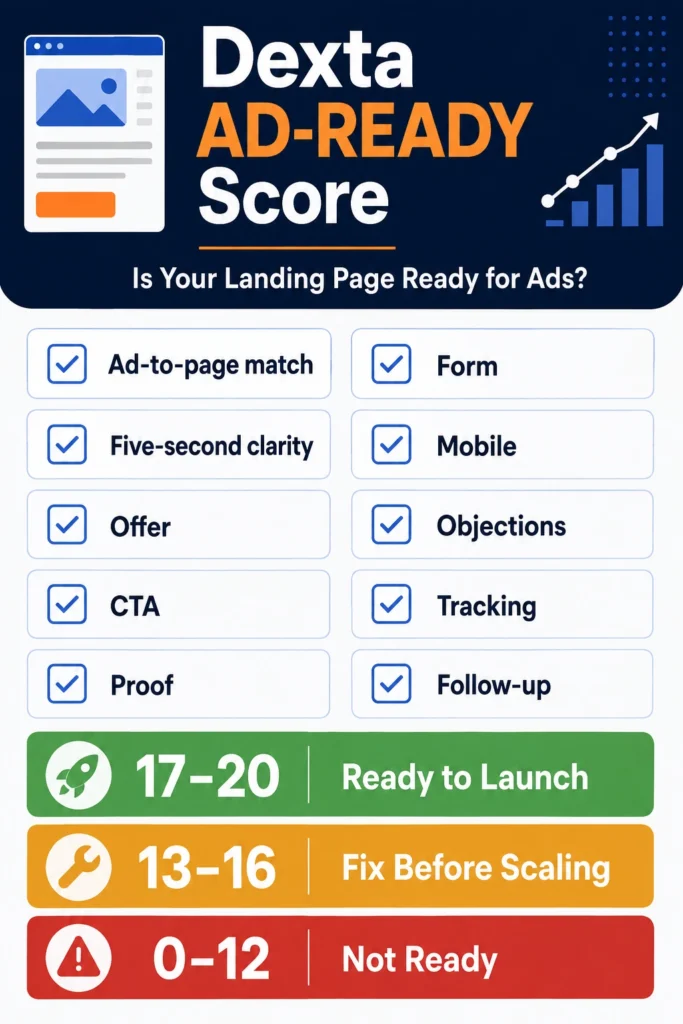
This landing page checklist before running ads helps beginners audit the complete journey before launching a Meta Ads or Google Ads campaign. Instead of giving you another long list of design tips, it uses Dexta Academy’s AD-READY Score: 10 checks, 2 points each and a clear launch decision.
Is Your Landing Page Ready for Ads?
Score every check below:
2 points: Clear, working and tested
1 point: Present but needs improvement
0 points: Missing, confusing or broken
| Score | Decision |
|---|---|
| 17–20 | Ready for a controlled campaign launch |
| 13–16 | Fix the weak sections before scaling |
| 0–12 | Do not send paid traffic yet |
This is a pre-launch filter, not a conversion guarantee. Performance also depends on the offer, audience, creative, competition and follow-up.
The Dexta AD-READY Landing Page Checklist
1. Ad-to-Page Match
The landing page must continue the promise made in the ad.
If the ad says “Free Digital Marketing Demo Class in Perinthalmanna,” the landing-page headline should repeat that offer. Sending the visitor to a general course page with “Build Your Future” creates doubt.
Check:
Does the headline match the ad’s offer and audience?
Are the location, price, date or eligibility details consistent?
Does the page use the same primary message as the creative?
Score 0–2: ___
2. Five-Second Clarity
A first-time visitor should understand three things without scrolling:
What is being offered?
Who is it for?
What should they do next?
A strong first screen needs a specific headline, one supporting sentence, a relevant visual and one clear CTA. Remove introductions such as “Welcome to our website.”
Five-second test: Show the first screen to someone unfamiliar with the campaign. Hide it after five seconds and ask the three questions above. If the answers are unclear, rewrite the hero section.
Score 0–2: ___
3. Offer Strength
A beautiful page cannot rescue a weak or vague offer.
“Contact us for more details” is not an offer. The visitor needs a reason to act now and a clear idea of what happens next.
For an academy, the offer may be:
Book a free course-counselling session
Register for a practical demo class
Check your eligibility for the next batch
Download the complete course syllabus
Explain what the visitor receives, any conditions and what happens after registration. Avoid false urgency and unsupported guarantees.
Score 0–2: ___
4. One Primary CTA
A campaign page should have one main conversion goal.
Do not give equal importance to “Call Now,” “Download Brochure,” “View All Courses,” “Follow Instagram” and “Chat on WhatsApp.” Too many competing actions make the decision harder and tracking less useful.
Use a specific CTA such as:
Book Your Demo Class
Check Course Eligibility
Get a Project Consultation
Request the Fee Details
Repeat the primary action after important sections. A secondary contact option should not compete visually with it.
Score 0–2: ___
5. Proof Near the Decision
People arriving through ads may not know the brand. Claims alone are not proof.
Place evidence close to the decision:
Genuine testimonials with meaningful context
Real student work or portfolio samples
Trainer experience and subject expertise
Classroom, office or team photographs
Clear placement-assistance information
Use accurate wording. Placement assistance should not be presented as a guaranteed job unless that promise can be supported.
See how Dexta connects training with outcomes on the placements page.
Score 0–2: ___
6. Form Friction and Lead Quality
Every field should have a purpose.
A short form can increase submissions, but the shortest form is not automatically best. One or two relevant questions may improve lead prioritisation.
For a course campaign, an initial form could ask for:
Name
Phone number
Current education or work status
Preferred learning mode
Submit the form yourself. Confirm that it works on mobile, shows a success message and sends the lead to the right person.
Score 0–2: ___
7. Mobile Speed and Usability
Do not approve a page only by looking at it on a desktop.
Open it on a real phone using mobile data and check:
Is the headline readable without zooming?
Is the CTA visible and easy to tap?
Does the form fit the screen?
Do pop-ups or sticky buttons cover the content?
Does the page feel slow before the first useful content appears?
Test more than the homepage load. Complete the entire conversion journey on the phone.
Score 0–2: ___
8. Objection Handling
Visitors often leave because one important question remains unanswered.
For a course page, common objections include:
Is this suitable for a beginner?
What are the eligibility requirements?
Is the training practical or theory-based?
What is the duration and schedule?
Is an internship included?
What does placement assistance mean?
Where is the academy located?
Answer major objections in the main content. Use the FAQ for remaining questions, not repetition.
Students comparing modules can review Dexta’s digital marketing course syllabus in Kerala.
Score 0–2: ___
9. Conversion Tracking
Do not launch if you cannot tell whether the main action happened.
Track the conversion that represents campaign success, such as:
Confirmed form submission
Demo-class registration
Thank-you page visit
Phone or WhatsApp click
Test that the event fires once at the correct step—not simply when someone opens the page.
Read Dexta’s guide to conversion tracking for beginners for an introduction to Meta Pixel, Google Tag Manager and GA4.
Score 0–2: ___
10. Lead Handover and Follow-Up
The landing page is not the end of the funnel.
Before launching, answer:
Who receives the enquiry?
How quickly can the team respond?
Is the source or campaign name recorded?
What happens if the first call is unanswered?
Where will lead status be updated?
Valid enquiries can still be lost through late contact, inconsistent handling or missing status updates.
To understand how campaign numbers connect with business results, read Digital Marketing Metrics: CTR, CPC, CPL, CPA and ROAS.
Score 0–2: ___
Meta Ads vs Google Ads: What Changes on the Landing Page?
The same checklist applies to both platforms, but visitor intent can be different.
| Area | Meta Ads traffic | Google Ads traffic |
| Typical situation | The ad interrupts browsing and creates interest | The person is actively searching for an answer or service |
| First-screen job | Build relevance and interest quickly | Match the search term and confirm the solution quickly |
| Proof needed | Visual proof, relatable outcomes and trust | Specific service details, expertise and comparison information |
| Offer approach | Low-friction demo, guide, enquiry or discovery step | Direct quote, consultation, booking or high-intent enquiry |
| Common mistake | Asking for commitment before building enough trust | Sending a specific search to a generic page |
The page should match the traffic source, keyword intent and stage of awareness.
Students can study each channel in more depth through Dexta’s Meta Ads Course in Kerala and Google Ads Course in Kerala.
Kerala Practice Example: Clicks Are Coming, Leads Are Not
Consider this classroom scenario—not a claimed client result:
A training institute runs an ad for a free weekend demo class. The campaign receives 500 landing-page visits but only eight registrations.
Before changing the audience, the AD-READY audit finds four problems:
The ad says “free weekend demo,” but the page says only “career-focused course.”
The registration button appears after a long introduction.
The mobile form contains nine fields.
The conversion event fires when the page loads, not after registration.
The campaign does not yet have a trustworthy cost per registration. Fix the message, CTA, form and tracking before judging the audience.
Kerala Practice Example: Clicks Are Coming, Leads Are Not
Use this exercise to turn the checklist into portfolio evidence:
Select a public course, service or local-business landing page.
Capture the mobile and desktop first screens.
Score all 10 AD-READY checks.
Identify the three highest-impact problems.
Rewrite the headline, supporting copy and CTA.
Reduce or improve the form fields.
Draw the conversion journey from ad click to follow-up.
Present the original score and proposed score.
Present untested changes as recommendations—not proven conversion improvements.
This campaign-thinking approach is part of Dexta Academy’s agency-based learning course in Kerala.
Before spending money, complete this journey yourself:
Ad preview → landing page → CTA → form → confirmation → conversion event → lead notification → follow-up
Then calculate the AD-READY Score.
Launch when the offer is clear, the action works, tracking is accurate and the team is ready.
At Dexta Academy, students learn to connect advertisements with landing pages, conversion tracking, lead quality and sales follow-up. Explore the Performance Marketing Course in Kerala or the complete Digital Marketing Course in Kerala to understand the training approach.
Frequently Asked Questions
What should I check before running ads to a landing page?
Check the ad-to-page message match, first-screen clarity, offer, CTA, proof, form, mobile experience, objection handling, conversion tracking and lead follow-up process.
How long should a landing page be?
There is no fixed ideal length. The page should include enough information to support the decision without repeating generic points. A simple offer may need a short page, while a higher-consideration course or service may require more proof and objection handling.
Should Meta Ads and Google Ads use the same landing page?
Not automatically. Meta visitors may need more context because the ad created their interest. Google Search visitors often expect an immediate match for a specific query. Use separate pages when intent or messaging differs significantly.
How many form fields should I use?
Ask only for information needed for the first response or qualification stage. Test the balance between submission volume and lead quality instead of assuming that fewer fields are always better.
Can a good landing page guarantee conversions?
No. Landing-page quality is one part of the result. The offer, audience, advertising creative, competition, budget, sales response and market demand also influence conversions.
About The Author

Raees Addox
Raees Addox is a digital marketing leader with 7+ years of industry experience, working at the intersection of digital marketing, sales, and AI. He is the Co-Founder of Addox Digital and Co-Founder & CEO of Dexta Academy.
0 Comment