

Instagram Ads can help a small business generate inquiries, bookings, website visits, and sales. But successful advertising is not about clicking the Boost Post button and hoping for results.
A good campaign needs:
- A clear objective
- The right audience
- A strong creative
- A clear offer
- Proper tracking
- Regular optimisation
At DEXTA Digital Expert Academy, students learn Instagram advertising as a practical business process. They do not only learn where to click inside Meta Ads Manager. They learn how to research an audience, build campaign ideas, test creatives, analyze performance, and connect ad results with real business outcomes.
This guide explains how small businesses can run Instagram Ads step by step.
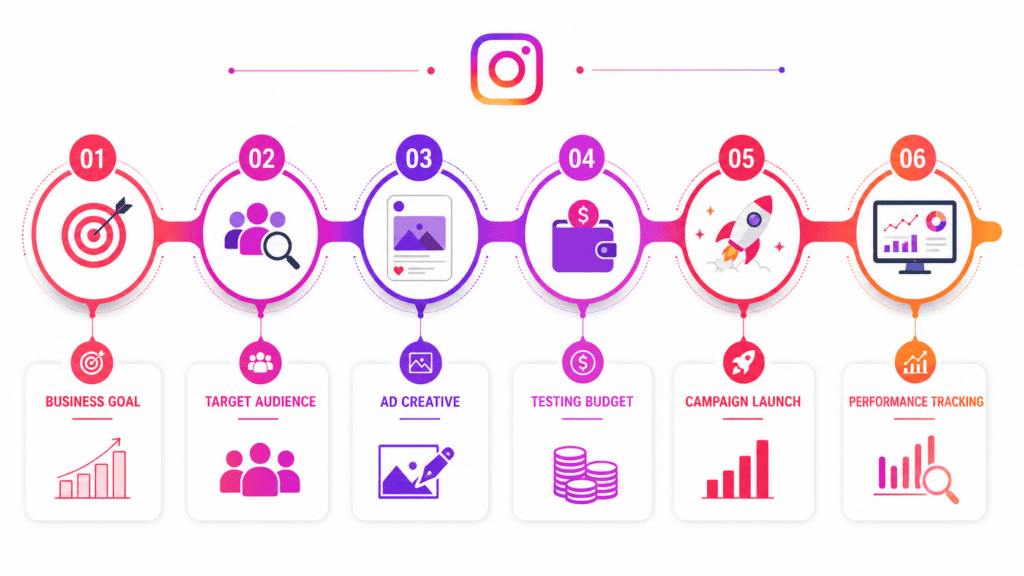
Quick Answer: How to Run Instagram Ads for a Small Business
To run Instagram Ads:
- Convert your Instagram profile into a professional account.
- Connect it to Meta Business Manager.
- Decide the business result you want.
- Choose the correct campaign objective.
- Define your ideal audience.
- Create multiple ad variations.
- Set a realistic testing budget.
- Launch through Meta Ads Manager.
- Track leads, sales, and cost per result.
- Improve the campaign using performance data.
The technical setup is important, but the creative offer, audience, and follow-up process usually have a bigger impact on the final result.
Why Instagram Ads Matter for Small Businesses
Organic Instagram content can build trust and visibility, but reach is not always predictable. Paid advertising allows businesses to reach people based on location, age, interests, behaviour and previous interaction.
Instagram Ads can work well for:
- Restaurants and bakeries
- Educational institutions
- Clinics and wellness centres
- Fashion brands
- Architects and interior designers
- Beauty salons
- Fitness centres
- Real estate businesses
- Local service providers
- Online stores
Small businesses can compete effectively when they understand their local audience, communicate clearly, and respond quickly to inquiries.
Instagram advertising works best when it is connected to a wider marketing strategy. Small business owners can also read this guide on how to promote a business in Kerala to understand how paid ads can work alongside content marketing, WhatsApp and local search visibility
Step 1: Decide the Campaign Goal
Do not start with the creative.
Start with the business result.
Ask:
- Do we need WhatsApp inquiries?
- Do we want website sales?
- Are we promoting a local store?
- Do we need appointment bookings?
- Are we collecting leads?
- Do we want more video views or brand awareness?
A bakery may want WhatsApp orders. A clinic may want appointment bookings. A training institute may want admission inquiries.
The campaign objective should match the final outcome.
Before launching a campaign, businesses should also decide how Instagram Ads fit into their overall lead-generation process. A structured digital marketing plan for Kerala small businesses can help connect campaign goals, content, follow-up, and sales.
Step 2: Set Up a Professional Instagram Account
A personal profile should be converted into a professional account before running advertisements.
A professional account gives access to:
- Instagram Insights
- Advertising features
- Audience data
- Contact buttons
- Meta Business tools
The Instagram account should also be connected to the correct Facebook page and Meta Business Portfolio.
This helps manage advertising assets, payment methods, permissions, and campaign reporting.
Step 3: Use Meta Ads Manager
The Boost Post option is useful for simple promotion, but it offers limited control.
Meta Ads Manager provides better control over:
- Campaign objectives
- Audience targeting
- Budgets
- Placements
- Multiple creatives
- Retargeting
- Custom Audiences
- Lead tracking
- Campaign reports
At DEXTA Academy, students are trained to use Meta Ads Manager because professional advertising requires more than increasing post reach.
They learn why a campaign is created, what metric should be measured, and how performance should be improved.
Readers who want practical learning in campaign planning, creative testing, and reporting can explore DEXTA Academy’s digital marketing course in Perinthalmanna.
Step 4: Choose the Right Campaign Objective
Meta provides different campaign objectives. The right one depends on the business goal.
Awareness
Use this when the goal is visibility, reach, or brand recall.
Suitable for:
- Store launches
- Event promotion
- New product introductions
- Local brand awareness
Traffic
Traffic campaigns send users to a website, landing page, WhatsApp, or another destination.
Clicks alone do not guarantee inquiries, so the destination page must also be strong.
Engagement
Engagement campaigns can support post-interaction, video views, and messaging.
They are useful when the goal is to encourage people to engage or begin a conversation.
Leads
Lead campaigns help businesses collect customer details through instant forms, calls, or messages.
They are commonly used by:
- Educational institutions
- Clinics
- Real estate companies
- Consultancies
- Service businesses
Sales
Sales campaigns are designed for purchases and conversion actions.
Businesses using this objective may need proper website tracking through tools such as Meta Pixel.
Step 5: Define the Ideal Customer
One of the most common mistakes is targeting everyone.
A better approach is to define the ideal customer clearly.
Consider:
- Age
- Location
- Language
- Buying capacity
- Interests
- Problems or needs
- Previous interaction with the brand
- Stage in the buying journey
Local Example
A bakery in Perinthalmanna does not need to target all of Kerala if it only delivers locally.
A more relevant audience may include the following:
- People within the delivery area
- Users likely to order for birthdays or celebrations
- Customers interested in cakes and food delivery
- An age group with stronger buying intent
Location targeting should match the actual service area.
Step 6: Create Ads That Stop the Scroll
People do not open Instagram to watch advertisements. They open it to watch Reels, Stories, creators, and entertainment.
A strong ad should quickly communicate the following:
- The customer problem
- The main benefit
- The offer
- The reason to trust the business
- The next action
A useful Instagram ad usually includes:
- A strong opening hook
- Clear visuals
- Simple messaging
- Real people or product demonstrations
- Proof or credibility
- A direct call to action
Weak Message
We provide high-quality digital marketing services.
Stronger Message
Running Instagram ads but still not getting inquiries? Your creative audience or follow-up process may be the real problem.
The second version gives the user a reason to continue reading or watching.
Step 7: Create Multiple Ad Variations
Professional advertisers rarely depend on one image or one video.
Before launching, create different variations such as:
- Customer-problem creative
- Product demonstration
- Testimonial
- Offer-based ad
- Founder-led video
- FAQ-style Reel
- Before-and-after creative
- Local-language video
One pattern students often notice during practical campaign analysis is that the audience is not always the main problem.
Sometimes the targeting is acceptable, but the creative does not generate attention or trust.
Improving the hook, visual style or offer can increase CTR and lower CPC without increasing the budget.
Organic content data can also reveal which topics, hooks, and formats already attract audience attention. Businesses can analyze Instagram Reel performance before adapting successful content ideas into paid advertisements.
Step 8: Match the Creative to the Placement
Instagram ads can appear across Feed, Stories, Reels, and Explore.
The creative should match the placement.
Reels and Stories
Use a vertical format with:
- A strong first few seconds
- Clear captions
- Fast communication
- A simple CTA
Feed
Feed ads can use:
- Single images
- Videos
- Carousels
- Product comparisons
- Case studies
- Before-and-after visuals
Avoid using the same creative everywhere without checking whether it fits each placement properly.
Step 9: Write Ad Copy Around the Customer
Small businesses often write advertisements entirely about themselves.
They focus on:
- Years of experience
- Quality
- Features
- Company background
These details matter, but they should connect to the customer’s problem.
A simple ad copy structure is:
Hook
Identify the problem or desired result.
Context
Explain why the problem happens.
Solution
Show how the business helps.
Proof
Add a result, testimonial, or credibility signal.
Call to Action
Tell the user what to do next.
Example
Getting Instagram views but not customer inquiries?
Likes alone do not grow a business. A campaign needs the right objective, audience, creative, and follow-up system.
We help local businesses plan campaigns around real inquiries and sales.
Message us on WhatsApp to discuss your campaign.
Simple copy is often more effective than complicated marketing language.
Step 10: Start with a Controlled Testing Budget
There is no single budget that works for every small business.
The required budget depends on:
- Location
- Competition
- Product value
- Campaign objective
- Audience size
- Creative quality
- Conversion rate
- Sales cycle
For some local businesses, ₹500 to ₹1,000 per day may be a useful starting test range. However, this is not a guaranteed formula.
The budget should be enough to generate meaningful data.
A common mistake is increasing the budget before confirming that the creative and offer are working.
In many cases, improving the advertisement first is better than immediately spending more money.
Step 11: Track the Right Metrics
Likes and followers can be useful, but they are not the final business result.
Important campaign metrics include:
CPM
The cost of 1,000 impressions.
CTR
The percentage of people who click after seeing the advertisement.
CPC
The average cost for each click.
Cost per Result
The cost per lead, message, purchase, or another selected action.
Frequency
The average number of times a person sees the advertisement.
High frequency with declining performance can indicate creative fatigue.
Conversion Rate
The percentage of users who complete the desired action.
ROAS
Return on ad spend.
This is important for businesses tracking direct revenue.
Metrics should be analyzed together. A low CPC does not automatically mean the campaign is profitable.
Step 12: Measure Lead Quality
A campaign can generate many leads and still fail to support the business.
Some leads may be
- Outside the service area
- Unable to afford the product
- Looking for a different service
- Unresponsive
- Duplicate enquiries
- Not ready to buy
This is why marketing and sales should work together.
At DEXTA Academy, students are introduced to the connection between digital marketing and digital sales.
They learn that a campaign does not end when a lead is generated. Response time, lead qualification, follow-up, and communication also affect the final outcome.
Practical Example: Instagram Ad for a Local Bakery
Imagine a bakery in Perinthalmanna wants to promote customized birthday cakes.
Business Goal
Generate WhatsApp orders.
Audience
People within the delivery area who may order cakes for birthdays and celebrations.
Creative Variations
- A short Reel showing the cake-making process
- A customer testimonial
- A carousel showing cake designs and starting prices
Offer
Order a customized birthday cake at least two days in advance.
Call to Action
Send the preferred design and event date through WhatsApp.
Metrics to Track
- WhatsApp conversations
- Cost per conversation
- Qualified enquiries
- Confirmed orders
- Revenue generated
The bakery should identify which creative produces actual orders, not only which creative receives the most views

How Meta Advertising Is Changing
Meta advertising is becoming more dependent on automation, conversion signals and creative variety.
Advertisers can no longer rely only on detailed interest targeting. The platform increasingly uses campaign signals, user behaviour and creative performance to identify relevant audiences.
Understanding the Meta Andromeda update can help advertisers see why strong creative testing now matters more than depending only on manual audience selection.
This does not mean audience research is no longer important. It means businesses should combine relevant targeting with stronger creatives, clear offers, and accurate conversion data.
Common Instagram Advertising Mistakes
Avoid these common mistakes:
- Using only the Boost Post button
- Targeting an unnecessarily large location
- Launching only one creative
- Using too much text in the design
- Promoting without a clear offer
- Ignoring mobile landing-page experience
- Tracking only likes and followers
- Responding slowly to leads
- Stopping the campaign too early
- Scaling before fixing the creative
Most campaigns do not fail because Instagram Ads do not work. They fail because the strategy, offer, creative, or follow-up system is weak.
Is Boost Post Enough?
Boost Post can be useful for simple visibility or engagement.
Meta Ads Manager is generally better when the business needs:
- Better objective selection
- Detailed targeting
- Retargeting
- Multiple advertisements
- Lead tracking
- Sales optimisation
- Placement analysis
- Structured reporting
Small businesses do not always need complicated campaigns. They need campaigns that connect clearly with business results.
Does a Small Business Need a Website?
A business can send users to the following:
- Instagram Direct Messages
- Instant lead forms
- Phone calls
A website or landing page becomes more useful when customers need the following:
- Detailed information
- Pricing
- Product selection
- Online payment
- Appointment booking
- Testimonials or proof
The destination should make the next action easy.
Frequently Asked Questions
How much do Instagram ads cost?
There is no fixed price. Cost depends on competition, audience, location, campaign objective, creative quality, and expected action.
Which objective is best for WhatsApp inquiries?
A campaign objective that supports messaging or lead-generation actions may be suitable. The right choice depends on the business setup and expected inquiry type.
Are Reels ads better than image ads?
Not always. Reels can generate strong attention, but image ads may work better for some offers. Testing both formats is usually more useful than assuming one will always win.
Why are leads not converting into sales?
The issue may be poor lead quality, delayed response, weak sales communication, unclear pricing, or inconsistent follow-up.
Why do Instagram ads get clicks but no inquiries?
Possible reasons include the following:
- Weak landing page
- Unclear offer
- Wrong audience
- Slow website
- Low trust
- Complicated CTA
- Ad and landing-page mismatch
The problem may happen after the click rather than inside the advertisement.
Can beginners learn Instagram Ads?
Yes. However, job-ready capability requires more than learning how to launch a campaign.
A digital marketer should also understand:
- Audience research
- Creative strategy
- Copywriting
- Lead generation
- Retargeting
- Analytics
- Reporting
- Sales funnels
- Conversion optimisation
Final Takeaway
Instagram Ads are not difficult because Meta Ads Manager does not have too many options.
They become difficult when a business launches without a clear goal, uses one generic creative, targets an undefined audience, and fails to track what happens after the inquiry.
Before launching, answer five questions:
- What business result do we want?
- Who is the right customer?
- Why should they pay attention?
- What action should they take?
- How will we measure the outcome?
At DEXTA Digital Expert Academy, students learn Instagram Ads as part of a complete practical marketing process that includes campaign planning, content strategy, analytics, lead management, and digital sales.
They do not only learn how to launch an advertisement. They learn how to understand its performance, improve it, and connect campaign results with real business growth.
Learn Instagram Ads Through Practical Campaign Experience
Build real skills in campaign planning, creative testing, audience targeting, analytics and lead management with DEXTA Digital Expert Academy.
About The Author

Raees Addox
Raees Addox is a digital marketing leader with 7+ years of industry experience, working at the intersection of digital marketing, sales, and AI. He is the Co-Founder of Addox Digital and Co-Founder & CEO of Dexta Academy.
0 Comment